Showing posts with label Trichet. Show all posts

Tuesday, May 12, 2009

Unlike the gormless arts students, limp-minded lawyers and woolly social scientists that dominate British and American economic policy making

From Willem Buiter:

"
Inflection points and turning points - since you asked
May 13, 2009 3:18am

The President of the European Central Bank, Jean-Claude Trichet, did not say that the recession was bottoming out. He said that it had reached an ‘inflection point’: “As far as growth is concerned, we’re around the inflection point in the cycle, that’s the sentiment,…” . Unlike the gormless arts students, limp-minded lawyers and woolly social scientists that dominate British and American economic policy making, President Trichet actually knows and understands mathematics. An inflection point is not a turning point.

Assume the cycle, C, can be represented as a twice continuously differentiable function of time, t, say

C = f(t)

What President Trichet was referring to was that, since the last quarter of 2008 or thereabouts, real economic activity had been declining in the Euro Area, that is, f’<0 or the first derivative (nothing to do with CDS) of activity with respect to time had been negative. Not only that, but it had been declining at an increasing rate, that is, f”<>. The reference to the inflection point means that President Trichet now believes that activity, while still declining, is no longer declining at an increasing rate but instead is now falling at a decreasing rate. That is, today, f”‘ > 0, passing through f”= 0 (the inflection point) along the way.

An inflection point is a point on a curve at which the curvature changes sign from concave downwards (upwards) to concave upwards (downwards), or, equivalently in the case under consideration, where the second derivative changes sign (f”(t) = 0 is not in general a sufficient condition for t to be a point of inflection. In addition, the lowest-order non-zero derivative must be of odd order (first, third, fifth, etc.). If the lowest-order non-zero derivative is of even order, the point is not a point of inflection. So if f” changes sign and f” has the same sign ‘before’ and ‘after’, we have a point of inflection. That’s why an inflection point is not a turning point.

A turning point is where the first derivative changes sign. In our current cyclical circumstances, we are all (the moving graph works with Firefox, I cannot get it to work with Internet Exporer - one more reason for switching to Firefox).
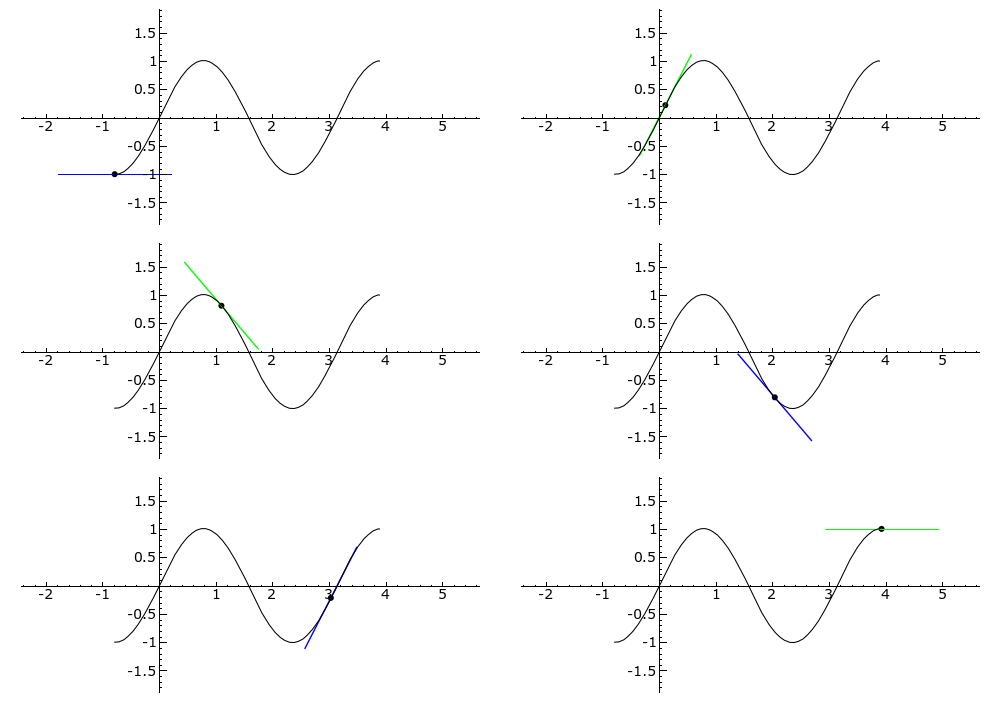
Animated illustration of an inflection point (from Wikipedia)Plot of f(x) = sin(2x) from − π / 4 to 5 * π / 4; note f’s second derivative is f”(x) = − 4 * sin(2x). Tangent is blue where curve is concave up (above its own tangent), green where concave down (below its tangent), and red at inflection points: 0, π / 2 and π.

President Trichet’s statement that the cycle is at an inflection point is therefore quite consistent with the IMF’s forecast that real economic activity in the Euro Area will continue to decline for this year and much of the next. Both Trichet and the IMF could of course be wrong, but it helps to be clear about what he actually said."

Me:

"The reference to the inflection point means that President Trichet now believes that activity, while still declining, is no longer declining at an increasing rate but instead is now falling at a decreasing rate"

I love the moving graph, but why couldn't he have just said that since we're all innumerate, or whatever the term is? By the way, he said, "we’re around the inflection point in the cycle". What color is "around the inflection point"? Posted by: Don the libertarian Democrat

Saturday, April 25, 2009

disinflationary process is, the greater of course the chance that in a certain moment people are going to react in a way we don’t want them to react

TO BE NOTED: From Bloomberg:

"ECB Options to Fight Recession Include Rate Floor, Wellink Says

By Simone Meier and Rainer Buergin

April 26 (Bloomberg) -- The European Central Bank is considering several options including a floor for its benchmark interest rate to fight the recession, said Nout Wellink, a member of its governing council.

“That’s one of the possibilities,” Wellink, who is also head of the Dutch central bank, said in an interview late yesterday in Washington. “When you have reached a certain level then you can influence reactions of economic agents by saying we will keep it at that level for a certain period.”

The ECB’s 22 council members appear split over how to counter the worst economic slump since World War II, at a time when the bank’s main rate is already at a record low of 1.25 percent. Germany’s Axel Weber has said the bank shouldn’t cut the rate below 1 percent. Others, including Athanasios Orphanides of Greece, want to keep open the option of deeper rate reductions and have argued in favor of asset purchases.

The debate prompted the Frankfurt-based ECB earlier this month to lower its key rate less than economists had forecast, by a quarter point, and to delay a decision on new policy tools until the council next meets on May 7.

The Federal Reserve and Bank of England have already cut lending rates close to zero and are buying government and corporate debt to bolster their economies. The Bank of Canada this week cut its key rate to 0.25 percent and said it plans to leave it there for more than a year.

Trichet Signals

While ECB President Jean-Claude Trichet has signaled another quarter point reduction in the main lending rate is likely next month, he has declined to comment on what new tools the bank will adopt. He said in Washington on April 24 that growth was unlikely to return “rapidly.”

Wellink said the ECB governing council is “looking into quite a number of options” without elaborating. His Belgian colleague Guy Quaden told reporters in Washington yesterday that the bank will probably lower its main rate by a “moderate” amount next month and implement unconventional monetary policies.

Quaden said he’s “pragmatic and absolutely not dogmatic” on whether the ECB should take more action beyond May. “We will have to closely monitor the risks for price stability and in the present circumstances it means the downside risks for price stability,” he said.

Wellink, who was in Washington for meetings of the International Monetary Fund and the World Bank, echoed Trichet and other colleagues in saying the recession will persist in the 16-member euro region even amid signs the economy is stabilizing. German business confidence rebounded more than economists forecast from a 26-year low in April, and consumer spending in France rose more than expected in March, data showed on April 24.

‘Less Positive’

Still, the economy may be “a little bit less positive” than than the central bank predicted in March, Wellink said. The ECB then forecast the euro region would shrink about 2.7 percent in 2009. The IMF this week projected a contraction of 4.2 percent.

The deepening slump has prompted companies to slash costs and prices, pushing inflation to less than half the ECB’s 2 percent limit. Wellink said the risk of deflation increased in recent months, yet isn’t yet a worry.

“A negative inflation rate by itself is not a problem, on the contrary it increases real disposable income,” Wellink said. “The lower and the longer the disinflationary process is, the greater of course the chance that in a certain moment people are going to react in a way we don’t want them to react. That is at this very moment not an issue.”

Other ECB officials in Washington shared Wellink’s view that a recovery isn’t yet assured. Council member Ewald Nowotny of Austria said yesterday that he sees positive signs and high uncertainty in the economy.

“At the moment, we have certainly the need for an expansionary policy,” Nowotny said.

To contact the reporter on this story: Simone Meier in Washington at smeier@bloomberg.netRainer Buergin in Washington at rbuergin1@bloomberg.net;"

Thursday, January 15, 2009

Core producer price inflation in December climbed to an annual 4.3 per cent rate

From the Times:

"
Global economy to shrink; deflation greatest threat, says UN

The deepening global recession means that the world economy as a whole could shrink next year and will battle to avoid destructive Thirties-style deflation, the United Nations said yesterday.

The UN alert over what threatens to be the worst year for the global economy since the Second World War came as fears of deflation were stoked when US producer price inflation slid into negative territory, registering an annual fall of 1.5 per cent last month.

In a bleak assessment of world prospects, the UN said that the global economy was now deteriorating at such a pace that its main projections in yesterday’s grim report were already out of date.

Rather than its main published forecast for world growth this year of a meagre 1 per cent, the UN said that its more pessimistic scenario of zero growth, or outright global decline by 0.4 per cent, was now more realistic.

Heiner Flassbeck, director of globalisation and development strategies at the UN Conference on Trade and Development (Unctad), said: “There is nothing unfortunately at the moment where we can say ‘this is positive’ or ‘this is giving a positive stimulus’ . . . For the world as a whole, the outcome could be zero, or even slightly below zero [growth]. I do not say this will go on for ever, but the coming months will get extremely tough.”

Mr Flassbeck said that the greatest threat now came from deflation( YES ) of the sort suffered during the Great Depression, when falls in wages of 10 to 15 per cent in some economies triggered a drastic slump in consumer demand and brought world growth to a virtual standstill.

With official interest rates across the West tumbling towards zero, the UN issued a call for coordinated fiscal stimulus packages in countries around the world, such as that being planned by the incoming Obama Administration in the US.( GOOD )

The European Central Bank yesterday stepped up its efforts to combat the eurozone recession, cutting interest rates by a further half-point to 2 per cent, equalling previous record lows for the single currency era. The ECB has now cut rates by 2.25 percentage points since October.

Jean-Claude Trichet, the ECB president, signalled that the bank was set to cut eurozone rates still further, but indicated that the next move would probably come in March. “We didn’t say that it was now the limit and we would not move any more,” he said.

Anxieties over deflation taking hold were multiplied, meanwhile, by yesterday’s US producer prices figures. The cost of goods leaving factories fell for a fifth month in a row, dropping by 1.9 per cent, or 1.5 per cent down on a year earlier.

Headline US inflation, for consumer prices, is also widely tipped to turn negative in further official figures today.

However, these trends still fall short of full-blown deflation of the destructive sort suffered in the Thirties, since they are so far driven almost entirely by the rapid reversal of the past surge in oil prices. These have now plummeted from record highs above $140 a barrel in July last year to reach levels yesterday just above $35.

So-called “core” US inflationary pressures, which strip out food and energy costs, remain far higher than headline inflation. Core producer price inflation in December climbed to an annual 4.3 per cent rate in yesterday’s figures, for example.( GOOD )

— The Russian rouble sank to historic lows against the dollar and euro yesterday as a growing threat of recession forced Moscow to further devalue the currency( WOW ).

After the Russian central bank widened the rouble’s permitted trading band for the fourth time in recent months, the currency fell to its lowest levels against the dollar since Russia opened up its economy in the Nineties, allowing the dollar to climb to 32.35 roubles. The euro also hit a record high of 42.55 roubles.

The move came with the once-booming Russian economy sliding as demand for its oil and gas slumps( NO EXPORTS )."

Monday, December 15, 2008

Violent unrest may be sparked around the world by a prolonged global slump unless governments act with greater urgency to jumpstart stalled economies

Gary Duncan on The Times with the head of the IMF's take on the EU Stimulus:

"Violent unrest may be sparked around the world by a prolonged global slump unless governments act with greater urgency to jump-start stalled economies, the head of the International Monetary Fund said on Monday."

I guess you could say that this is one of my main concerns.

"Dominique Strauss-Kahn sounded a stark warning over the consequences of what he argued was weak and uncertain government reaction to the economic crisis. He used a hard-hitting speech in Madrid to single out eurozone nations over what he attacked as an inadequate response.

The broadside from the IMF's managing director came as fears over a protracted global recession, and political fallout, mounted after China said that its factories' output registered the weakest growth in almost a decade last month.

Without swifter and more determined action by governments to boost economies, a world recovery could be delayed until late next year or early in 2010, with grave consequences, Mr Strauss-Kahn said. “A lot remains to be done, and if this work is not done it will be difficult to avoid a long-lasting crisis that everyone wants to avoid.”

I tend to agree with him.

"The IMF has called for governments in leading economies to spend a combined 2 per cent of global GDP, or $1.2 trillion (£1,075 billion), to try to fend off the danger from global recession.“If we are not able to do that, then social unrest may happen in many countries - including advanced economies,” Mr Strauss-Kahn suggested.

He also claimed that violent protests could break out in countries worldwide if the financial system was not reordered to benefit everyone rather than a small elite."

This is one of my main fears.

"Reinforcing anxieties over a global recession, the IMF chief said that the fund would probably cut its current 2.2 per cent forecast for world growth next year. He blamed governments' being unwilling or unable to use more public funds to bolster economic activity. At the same time, he also predicted that China's once red-hot pace of economic expansion was now set rapidly to run out of steam.

“We started with China at 11 per cent growth . . . China will probably grow at 5 or 6 per cent [next year],” he said. “The possibility of a global recession is real. We realise something must be done.”

Concern over China was heightened as industrial output growth from the Asian powerhouse slowed to an annual pace of only 5.4 per cent last month. That was sharply from 8.2 per cent in October and the weakest since 1999."

This seems to be occurring.

"Turning his fire on the European Union, Mr Strauss-Kahn put himself sharply at odds with Jean-Claude Trichet, President of the European Central Bank, who yesterday urged European leaders to stick to their fiscal rule books and keep a lid on state borrowing, even as they deliver packages of economic stimulus measures.

Mr Trichet called for European countries to stick by the EU's controversial Stability and Growth Pact that limits governments' borrowing and total debt. But Mr Strauss-Kahn said that existing rule books should be scrapped, and demanded new rules to match the scale of the economic threat he saw."

I understand Trichet's caution, but believe he underestimates the seriousness of the problem.

“We are facing an unprecedented decline in output and we have evidence of substantial uncertainty limiting the effectiveness of some fiscal policy measures,” he said, “What was decided by Brussels . . . 1.5 per cent of GDP in the form of stimulus, is a bit below what we need.”

His comments come amid continued wrangling and sharp clashes between European leaders over how they should react to the crisis."

I'm not convinced that it's all real

"Germany has expressed substantial doubts over the wisdom of pumping huge amounts of public money into economies to try to stimulate growth and has resisted pressures to contribute more to a joint EU effort.

Peer Steinbrück, the German Finance Minister last week delivered an outspoken attack on tax and spending-led stimulus measures generally, and Britain's in particular.

“The same people who would never touch deficit spending are now tossing around billions,” he told Newsweek, in an interview. “The switch of supply-side politics all the way to a crass Keynesianism is breathtaking.” Discussing Britain's cut in value-added tax, he added: “All this will do is raise Britain's debt to a level that will take a whole generation to work off.”

He's as good an act as Yosano.

"Any acknowledgement that stable dollar adjustments are a policy priority should help prevent a dollar run. "

Free Exchange with two points about earlier posts. First, the Tim Duy point that using the Great Depression as a guide in our current crisis might be of limited use, especially where Quantitative Easing is concerned:

"And Tim Duy speculates that because of the lingering current account deficit, America's shaky dollar could be approaching a dangerous adjustment. Enough downward pressure on the dollar could begin to affect Treasury rates. And the Federal Reserve, focused like a laser beam on preventing deflation and depression, might simply work to hold those rates down by buying Treasuries and plowing still more money into the economy. And then? Well, America could begin to have trouble financing its borrowing, and could then face the need to either pursue strongly pro-cyclical fiscal policies or hyperinflationary monetary policies.

There are a lot of ifs in all of that. It would be nice to have a probability distribution for all of the different potential catastrophic outcomes facing the global economy, in order to know which lesser evil to aim for. Had we one, I suspect this concern would turn up in far fewer die rolls than the standard depression outcome. Still, it seems worth paying attention to the conflict underlying the whole thing—that America's optimal policy choices now are not quite the same as they were in the 1930s, since America's role in the global economy has changed.

Because once that conflict is understood, American leadership can be proactive. Any acknowledgement that stable dollar adjustments are a policy priority should help prevent a dollar run. And more importantly, Barack Obama's economic team should begin to consider how best to cajole large creditor nations with current account surpluses to spend heavily on stimulus and boost domestic consumption.

There's no particular reason that America has to make policy in a vacuum, just hoping that trading partners don't do anything radically destabilising. Leaders globally need to understand that they have a mutual self-interest in unwinding global imbalances while also providing coordinated stimulus. And leaders among those leaders need to lead."

I've said much the same thing, only with less expertise.

Now, about Germany and the EU Stimulus:

"Jean-Claude Trichet, head of the European Central Bank, argued today in favour of European fiscal discipline and adherence to the Stability and Growth Pact. A noble sentiment, but one that's potentially troublesome given Mr Trichet's recent signals that the ECB is ready to pause in its rate cutting, and given Germany's reluctance to pursue bold fiscal stimulus. Germany said last night that no new stimulus plans would be forthcoming until it was clear what stimulus policies Barack Obama might pursue in office. Just why isn't clear. Mr Obama's stimulus is likely to be at least $500 billion in magnitude, and it's hard to know why the structure of the plan—tax cuts or local budget grants or infrastructure investment—would influence German choices."

I suspect that the wait for President Obama's Stimulus Plan is actually aimed more at domestic politics, since I concur in finding Germany's wait puzzling. But it is true that the amount of the US Stimulus might have an impact on how necessary a coordinated stimulus plan is, and how much each nation should spend. It could simply be prudence.