Showing posts with label The Fed. Show all posts

Sunday, April 12, 2009

right demand for excess reserves to ensure the desired inflation rate, by paying the right interest rate on reserves

TO BE NOTED: From Financial Crisis And Recession:

"The Fed Needs to Make a Policy Statement

More and more one hears the concern that the Fed has embarked on an expansionary policy that will result in high inflation once the economy returns to normal. John Taylor, a leading expert in this area, put the argument as follows, in recent Congressional testimony:

… the enormous increase in reserves is potentially inflationary. Many people ask me if it is inflationary, so I know it is on people’s minds. With the economy in a weak state and commodity and many other prices falling, inflation is not now a problem, but at some time the Federal Reserve will have to remove these reserves or we will have a large increase in inflation…Recall that increases in money growth affect inflation with a long lag. The question is whether the Fed will be able to reduce the reserves in time and whether people will expect the Fed to do so. If reserves get to the level [implicit in recent policy announcements] it will have to sell a huge amount of securities backed by consumer credit, mortgages, student loans, and auto loans. This will be difficult to do politically.

Chairman Bernanke responded to this view in January, but his answer–basically what we view as the correct one–received little attention and did not alleviate the misconception of incipient inflation that has spread widely since then.

A common way to express the concern is that the Fed has created huge amounts of money and that it will not be able to shrink the money supply in time to avert inflation as the economy recovers. This way of expressing the issue is completely confusing, because it equates reserves with money. The Fed now pays interest on reserves, so the connection of reserves to money is not mechanical but requires a modern analysis that includes the role of the interest rate on reserves. Though many central banks now pay interest on reserves, the extension of monetary theory to include that new factor has remained obscure. Only little-known academic studies such as “Controlling the Price Level” and “Optimal Fiduciary Monetary Systems” considered the issue.

Reserves are interest-bearing obligations of the Federal Government, enjoying the same safety and liquidity as Treasury bills. Reserves form the core of the payments system. Anybody can trade reserves dollar-for-dollar for currency by cashing a check, withdrawing from an ATM, or depositing currency in a bank account. Financial obligations stated in dollars can be met definitively by writing a check, which is an instruction to one bank to transfer reserves to another bank.

Banks must hold reserves of 10 percent of the amounts in their depositors’ checking accounts (required reserves), but this requirement is not binding today, as banks are holding vastly more than their required reserves.

When the Fed pays interest on reserves at a rate well below market rates–in particular, well below the Fed funds rate governing borrowing and lending among banks–banks economize on reserves. If the margin between the Fed funds rate and the reserve rate is large, say several percentage points, banks will hold only required reserves. In this case, standard old-fashioned monetary theory applies, taught to generations of freshman principles students as the “multiple expansion of deposits.” Suppose we start with deposits of $100 billion and reserves of $10 billion, so banks hold no reserves in excess of requirements. Then the Fed creates another $1 billion of reserves. Banks will expand their activities to try to avoid holding excess reserves, which are undesirable because they pay interest far below market rates. The economy expands as a result, depositors hold more in their checking accounts–$110 billion to be precise–and banks no longer hold excess reserves. The economic expansion is a combination of more real activity and higher prices. An expansion of reserves raises the rate of inflation over some period, generally thought to run from about a year after the expansion to around four years.

This conventional analysis always applied when the Fed paid zero interest on reserves and market rates were in the range of 5 percent or more. Banks used sharp-pencil policies to avoid holding excess reserves. Manipulation of the quantity of reserves gave the Fed powerful and direct and direct control over economic activity and inflation.

When reserve interest rates and the Fed funds interest rate are close to each other, the situation is quite different. Banks are happy to hold excess reserves which pay just as much as could be earned on other safe investments. Expansion of reserves results mainly in expansion of excess reserves and has little effect on bank lending. Rather than stimulating economic activity and raising the volume of bank deposits, an expansion of reserves just adds to banks’ holdings of reserves. The Fed loses its control over economic activity. In particular, expansion of reserves is not inflationary when the reserve rate and Fed funds rate are the same. There is no risk of excess inflation in today’s economy.

Equality of the reserve rate and the funds rate comes about in two ways. One is for the funds rate to fall toward the reserve rate. Prior to October 2008, the reserve rate was always zero. Thus, as the funds rate approaches zero, the mechanical connection between reserves and economic activity vanishes. This limitation on the Fed’s ability to stimulate the economy has long been known.

The second way the two rates could become equal is for the reserve rate to rise to the level of the funds rate (or even a bit above, as it has since October). Note that both factors have operated in recent months. When the Fed started to pay interest on reserves in October, it set the rate at 0.75 percent or 75 basis points. The current rate is 25 basis points.

Raising the reserve interest rate is a contractionary measure. A higher interest rate on reserves makes banks more likely to hold reserves rather than increasing lending. The Fed’s decision to raise the reserve rate from zero to 75 basis points just as the economy entered a sharp contraction in activity is utterly inexplicable. Fortunately, the Fed lowered the reserve rate subsequently, but the continuation of a positive reserve rate in today’s economy is equally inexplicable. Some economists have proposed that the Fed charge banks for holding reserves, an expansionary policy worth considering. With the Fed funds rate at around 15 basis points, it would take a charge to restore the differential that drives banks to lend rather than hold reserves. Were the Fed to charge for reserves, they would become the hot potatoes that they were in the past, when the reserve rate was zero and the Fed funds rate 4 or 5 percent. Banks would expand lending to try not to hold the hot potatoes and the economy would expand. There is no basis for the claim that the Fed has lost its ability to steer the economy. (However, the Fed would have to go to Congress to get this power, as it did to get the power to pay positive interest on reserves.)

The basic point emerging from the analysis of the role of the reserve interest rate is simple: The margin between the Fed funds rate and the reserve rate is a potent new tool for stabilizing the economy. When the Fed wants to expand, it should raise the margin. In today’s economy, this would call for a negative reserve rate, that is, a charge to banks for holding reserves. When the time comes to move to a tighter policy, the Fed should lower the margin. At that time, the Fed would raise the reserve rate for two reason: first to reduce the margin and second to follow increases in market interest rates that will occur in a recovery.

So the question John Taylor posed–how can the Fed control inflation in coming years when it is committed to have a large volume of reserves outstanding to finance its purchases of illiquid assets?–has a simple and effective answer: The Fed should raise the rate its pays on reserves as needed to control economic activity and inflation. It is unnecessary for the Fed to cut its reserves to low levels once the economy approaches normal conditions. Rather, it only needs to raise the reserve interest rate to a point sufficiently close to market rates to make banks willing to hold excess reserves.

How should the Fed pick the level of the reserve interest rate? The policy for the reserve rate should be basically the same as the successful policy for the Fed funds rate that delivered exceptional stability to the economy from the mid-1980s until the current crisis. During that period, the Fed set the funds rate adaptively–when the economy seemed headed for overheating and excess inflation, it raised the funds rate to cool the economy off. When the economy stumbled, as in 2001 and in 2008, the Fed cut the funds rate to low levels. The resulting record on inflation was outstanding–the inflation rate remained in a tight band centered on about 2.5 percent. One of the best ways to judge the performance of the Fed is to look at the consensus forecast for inflation over the coming two years. For the past 20 years, the forecast was right on 2 to 3 percent with few exceptions. Today the consensus is for too little inflation–only 1.2 percent in 2009 and 2010 and 1.7 percent in 2011. So inflation forecasts call for expansion. Once the forecast rises to around 2.5 percent for the coming two years, the Fed should raise the reserve interest rate and reduce the volume of reserves (to the extent permitted by the liquidty of its portfolio at that time) as needed to keep the forecast at around 2.5 percent. The Fed can pick a combination of a higher reserve rate and a lower volume of reserves to cool the economy sufficiently to keep inflation on tdarget.

The Fed needs to issue a pronouncement along the following lines to assure the public that there is no need for concern about inflation after the receovery and to reaffirm its historical commitment to stable and low inflation:

The Federal Reserve is fully committed to a policy of stable and low inflation. Though the Fed has not adopted a quantitative target for a specific measure of inflation, its actual performance over the period from 1987 through 2007 is indicative of its goal for the future. The Fed will continue its efforts to expand the economy this year, when inflation appears to be well below its normal range. Its past and planned expansionary policies during the current period of extreme stress will result in a large expansion of reserves. The Fed will use its authority to pay interest on reserves as needed to prevent excessive inflation as the economy recovers.

Even the St. Louis Fed has missed the point that reserve interest policy can take care of an overhang of reserves. An article in its Review that discusses interest on reserves nonetheless concludes.

The key is that the Fed will have to drain reserves when the economy begins to recover if it is to prevent a rapid acceleration of inflation. That necessity drives the current discussion of exit strategies.

The (incorrect) logic in the article is that as long as the Fed has a high volume of reserves outstanding, they must be held by the banking system and thus the monetary base must be large and inflationary. It misses the point that banks can be coaxed into just the right demand for excess reserves to ensure the desired inflation rate, by paying the right interest rate on reserves. The exit strategy from the Fed’s holdings of illiquid asssets need not be constrained by concerns about inflation, becuase reserve-rate policy can take care of inflation.

Tuesday, April 7, 2009

saying its members “strongly believe” that TALF loans should be at least five years.

TO BE NOTED: From Bloomberg:

"Fed Said to Weigh Charging Higher Rates for Longer TALF Loans


By Scott Lanman

April 7 (Bloomberg) -- The Federal Reserve may offer investors longer-term loans at higher interest rates to buy commercial mortgage-backed securities, aiming to protect the central bank’s balance sheet while acceding to an industry plea.

Lobbyists in the commercial mortgage-backed securities industry say the Fed needs to provide loans of at least five years, rather than the current three-year limit, to avert a meltdown in the market. Fed officials, wary of granting the request outright, are considering a compromise in altering terms of its $1 trillion emergency-lending program.

Fed policy makers are wary of loosening limits on the Term Asset-Backed Securities Loan Facility because longer loans would make it more difficult to tighten credit when inflation picks up. At the same time, rejecting the industry’s request may further stymie the TALF after a slow start that’s hindering Chairman Ben S. Bernanke’s efforts to revive the economy.

Charging higher rates for longer terms, “as a compromise, seems like it meets the needs of both sides,” said Louis Crandall, chief economist at Wrightson ICAP LLC in Jersey City, New Jersey. “It’s the certainty of the funding, and providing certainty goes a long way to address those concerns.”

Today, the Fed received applications to borrow $1.7 billion in the TALF’s second monthly round, down 64 percent from $4.7 billion in March. Hedge funds and other investors are balking because of visa limits on workers and possible efforts to tax earnings, undermining Bernanke’s attempt to further drive down borrowing costs.

TALF Expansion

The Fed started the TALF last month, lending to investors purchasing securities backed by auto, credit-card, education and small-business loans. In coming months, the program will expand to include securities backed by commercial real-estate loans.

“We have been advocating strongly for a term of at least five years,” said Christopher Hoeffel, president of the Commercial Mortgage Securities Association, a trade group. “The most important thing is the term of the loan. If the cost of the financing and the equity requirement increased with the length of the loan, that would be a workable solution.”

Investor participation would be curtailed by a loan term of less than five years, said Hoeffel, who is also a managing director at Investcorp.

Fed officials are still devising terms for the expanded facility, which may reach $1 trillion. No decisions have been reached yet on the loan length. Sales of CMBS plummeted to $12.2 billion last year from a record $237 billion in 2007, according to estimates by JPMorgan Chase & Co.

Risk of Default

That raises the risk of increasing defaults on commercial mortgages, making it tougher for borrowers to refinance maturing debt and avoid delinquency or foreclosure, industry officials say.

Charging higher fees after three years would be a compromise aimed at giving more incentive for investors to borrow from the Fed and helping restart markets for commercial mortgage-backed securities, while protecting the Fed’s flexibility to raise interest rates in the broader economy once consumer demand recovers.

The Fed normally raises the benchmark federal funds rate by selling Treasuries on its balance sheet, draining reserves from the banking system. That task is tougher with the Fed’s commitment last month to buy more than $1 trillion in mortgage- backed securities, which are harder to sell quickly without roiling markets or potentially attracting political scrutiny. TALF loans in particular would be difficult for the Fed to move.

Loan Rates

Investors can take out a fixed-rate TALF loan to buy newly issued auto-loan securities at the one-month London interbank offered rate, or Libor, plus 1 percentage point. For today’s loan applications, that comes to 2.87 percent, the Fed said.

One potential solution under consideration would be to increase the spread over Libor to, for example, 200 basis points after three years and 300 basis points after the fourth year. The thinking is that rates for private-market financing would decline enough in the next three years to make Fed loans too pricey for investors to keep.

Commercial Mortgage Securities Association officials said last month that the government’s effort to boost bids for the commercial-mortgage bonds may fail unless the length of TALF financing is increased.

The group posted on its Web site a summary of recommendations dated March 25, saying its members “strongly believe” that TALF loans should be at least five years."

Sunday, March 29, 2009

What we need in the current situation is a central bank that is a bulwark of stability.

TO BE NOTED: From Econbrowser:

"
The Fed's new balance sheet

My previous post reviewed the profound changes in the balance sheet of the U.S. Federal Reserve over the last 18 months. Here I comment on some of the concerns that the new Fed balance sheet raises for the conduct of monetary policy.

I would suggest first that the new Fed balance sheet represents a fundamental transformation of the role of the central bank. The whole idea behind open market operations is to make the process of creating new money completely separate from the decision of who receives any fiscal transfers. In a traditional open market operation, the Fed buys or sells an existing Treasury obligation for the same price anyone else would pay for the security. As a result, the operation itself does not involve any net transfer of wealth between the Fed and the private sector. The philosophy is that the Fed should base its decisions on economy-wide conditions, and leave it entirely up to the market or fiscal authorities to determine where those funds get allocated.


Assets of the Federal Reserve, in billions of dollars, seasonally unadjusted, from Jan 3, 2007 to March 25, 2009. Wednesday values, from Federal Reserve H41 release. Agency: federal agency debt securities held outright; swaps: central bank liquidity swaps; Maiden 1: net portfolio holdings of Maiden Lane LLC; MMIFL: net portfolio holdings of LLCs funded through the Money Market Investor Funding Facility; MBS: mortgage-backed securities held outright; CPLF: net portfolio holdings of LLCs funded through the Commercial Paper Funding Facility; TALF: loans extended through Term Asset-Backed Securities Loan Facility; AIG: sum of credit extended to American International Group, Inc. plus net portfolio holdings of Maiden Lane II and III; ABCP: loans extended to Asset-Backed Commercial Paper Money Market Mutual Fund Liquidity Facility; PDCF: loans extended to primary dealer and other broker-dealer credit; discount: sum of primary credit, secondary credit, and seasonal credit; TAC: term auction credit; RP: repurchase agreements; misc: sum of float, gold stock, special drawing rights certificate account, and Treasury currency outstanding; other FR: Other Federal Reserve assets; treasuries: U.S. Treasury securities held outright.

The philosophy behind the pullulating new Fed facilities is precisely the opposite of that traditional concept. The whole purpose of these facilities is to redirect capital to specific perceived priorities. I am uncomfortable on a general level with the suggestion that unelected Fed officials are better able to make such decisions than private investors who put their own capital where they think it will earn the highest reward. Apart from that general unease, I have a particular concern about the motivation for the Term Asset-Backed Securities Loan Facility, whose goal is to generate up to $1 trillion of lending for businesses and households by catalyzing a revival of loan securitization. I grant that securitization was an enormously successful device for funneling vast sums into sundry loans. For example, securitization successfully turned 80% of quite shaky subprime loans into Aaa-rated assets. To put that in perspective, only five U.S. companies currently have the ability to issue Aaa-rated debt. So yes, a device that transformed weak loans into Aaa-rated debt was marvelously successful at attracting capital from all over the world into U.S. private lending.


Ratio of total mortgage debt (from Table L.2 of Flow of Funds Accounts) to nominal GDP (from BEA Table 1.1.5).
mortgage_gdp.gif

But the whole premise behind those Aaa ratings-- that securitization could isolate a "safe" component of a pool of fundamentally risky loans-- was deeply flawed. It is impossible to diversify away aggregate or systemic risk. All that the device did was to mislead investors into thinking they were protected from those nondiversifiable risks and push those risks onto the taxpayers and the Fed. Before we decide that securitization is the road out of our present difficulties, I would like a detailed and convincing explanation of why the past mistakes are not going to be repeated again.

A second concern I have with the new Fed balance sheet is that it has seriously compromised the independence of the central bank. To my knowledge, every hyperinflation in history has had two key ingredients: (1) budget deficits that could not be resolved politically, and (2) a central bank that assumed the obligations that the fiscal authority could not.

In the U.S. today, there is little question in my mind that repaying the projected deficits with tax increases or spending cuts will be extremely difficult politically. Each additional trillion dollars would roughly require doubling the personal income tax rate on all Americans for one year, something I cannot see the political process delivering. There is enormous pressure in the current situation to defer solutions and look for temporary fixes with off-balance-sheet measures. The reason that the Fed is sought as a partner for the Treasury in all these new actions is because the Fed is perceived to have deeper pockets than the Treasury. This is not a situation that a self-respecting central bank should let itself get into.

My third concern is that the new Fed balance sheet has handicapped the Fed's ability to fulfill its primary mission, which I see as promoting a stable and predictable low rate of inflation. Which of the Fed's new assets would it sell off when it needs to absorb back in the huge volume of reserves it has recently created? The Fed's hoped-for scenario is that the reserves won't need to be called back in until the situation has stabilized and the facilities are no longer needed. But I am concerned instead about the possibility of a dramatic shift in the perceptions of foreign lenders, in which case inflationary pressures could emerge in a situation that is far more chaotic than the one we currently face.

I recommend instead that the Fed should be buying Treasury Inflation-Protected Securities in the current situation. Tim Iacono says that's like the Mafia buying "protection" from itself. But my point is that TIPS represent an asset that would gain in value at a time the Fed needs to sell them, meaning that the logistical ability of the Fed to drain reserves quickly in such circumstances is without question.

What we need in the current situation is a central bank that is a bulwark of stability. A profound lack of confidence in the U.S. government itself would make our current problems look like a walk in the park. If the Fed had the means and the credibility to deliver a stable and low inflation rate, I believe that would go a long way to solving our current problems.

But it's not clear the Fed has either the means or the credibility."

Saturday, March 28, 2009

Plan B is for the Fed to borrow directly from the public

TO BE NOTED: From Econbrowser:

"
Money creation and the Fed

A lot of people have seen this picture of the recent behavior of the monetary base and wondered what it means.


Figure 1. Adjusted monetary base. Source: FRED.
mon_base_mar_09.jpg

To understand the explosion in the monetary base since September, let's begin with a little background. The Federal Reserve has the ability to purchase assets or make loans with funds (money) that are created by the Fed itself. To buy a billion dollars worth of assets, the Fed doesn't show up with new cash in a wheelbarrow. Instead the Fed pays for any assets it purchases or loans it extends by crediting the funds that the recipient bank has in an account with the Fed, known as reserve deposits. A bank can later withdraw those deposits in the form of green currency, if it chooses, and that's the point at which an armored truck from the Fed would be involved with physical delivery of cash.

The monetary base is essentially the sum of (1) the currency that's been withdrawn from private banks and is being held by the public, (2) the currency that's sitting in the vaults of private banks that could potentially be withdrawn by the banks' customers if they wanted, and (3) banks' reserve deposits, which you could think of as electronic credits for currency that the banks could ask for from the Fed any time the banks choose. Historically, newly created reserve deposits have usually shown up pretty quickly as currency withdrawn by banks and then by the public. Choosing a pace at which to allow that supply of currency to grow so as to accommodate the increased currency demands from a growing economy without cultivating excessive inflation is one of the main responsibilities of the Fed.

Figure 2 below plots the assorted "factors absorbing reserve funds" from the Fed's H41 release during the halcyon period from 2003 to the middle of 2007. At that time, currency held by the public was by far the biggest component in the liabilities side of the Fed's balance sheet, with the currency supply increasing 20% over these 5 years and with temporary seasonal bumps to accommodate the annual Christmas surge in currency demand. Reserve deposits (the sum of the "reserves" and "service" components in Figure 2) were quite minor relative to total quantity of currency in circulation.


Figure 2. Factors absorbing reserve funds, in billions of dollars, seasonally unadjusted, from Jan 7, 2003 to June 27, 2007. Wednesday values, from Federal Reserve H41 release. Treasury: sum of U.S. Treasury general and supplementary funding accounts; reserves: reserve balances with Federal Reserve Banks; misc: sum of Treasury cash holdings, foreign official accounts, and other deposits; other: other liabilities and capital; service: sum of required clearing balance and adjustments to compensate for float; reverse RP: reverse repurchase agreements; Currency: currency in circulation.

With this increase in newly created money, the Fed was over this period acquiring assets primarily in the form of short-term Treasury securities, which holdings grew 25% over this 5-year period. The Fed at that time used short-term repurchase agreements as a device for adjusting the supply of reserves on a temporary basis. Note that for each date the height of the components in Figure 3 below (essentially the asset side of the Fed's balance sheet) is exactly equal, by definition, to the height of the liabilities portrayed in the previous Figure 2.


Figure 3. Factors supplying reserve funds, in billions of dollars, seasonally unadjusted, from Jan 7, 2003 to June 27, 2007. Wednesday values, from Federal Reserve H41 release. Agency: federal agency debt securities held outright; swaps: central bank liquidity swaps; Maiden 1: net portfolio holdings of Maiden Lane LLC; MMIFL: net portfolio holdings of LLCs funded through the Money Market Investor Funding Facility; MBS: mortgage-backed securities held outright; CPLF: net portfolio holdings of LLCs funded through the Commercial Paper Funding Facility; TALF: loans extended through Term Asset-Backed Securities Loan Facility; AIG: sum of credit extended to American International Group, Inc. plus net portfolio holdings of Maiden Lane II and III; ABCP: loans extended to Asset-Backed Commercial Paper Money Market Mutual Fund Liquidity Facility; PDCF: loans extended to primary dealer and other broker-dealer credit; discount: sum of primary credit, secondary credit, and seasonal credit; TAC: term auction credit; RP: repurchase agreements; misc: sum of float, gold stock, special drawing rights certificate account, and Treasury currency outstanding; other FR: Other Federal Reserve assets; treasuries: U.S. Treasury securities held outright.

Beginning in September 2007, the Fed began a process of systematically changing the nature of its asset holdings. Over the course of the next year, the Fed sold off over $300 billion in Treasury securities (about 40% of its holdings of Treasury securities), and replaced them with $150 billion in direct bank lending in the form of term auction credit, $60 billion in loans to foreign central banks in the form of liquidity swaps, and $100 billion in repurchase agreements, used now not for temporary adjustments but instead as a device to create a market for MBS by accepting alternative assets as collateral.


Figure 4. Factors supplying reserve funds, in billions of dollars, seasonally unadjusted, from Jan 3, 2007 to August 27, 2008. Wednesday values, from Federal Reserve H41 release. Agency: federal agency debt securities held outright; swaps: central bank liquidity swaps; Maiden 1: net portfolio holdings of Maiden Lane LLC; MMIFL: net portfolio holdings of LLCs funded through the Money Market Investor Funding Facility; MBS: mortgage-backed securities held outright; CPLF: net portfolio holdings of LLCs funded through the Commercial Paper Funding Facility; TALF: loans extended through Term Asset-Backed Securities Loan Facility; AIG: sum of credit extended to American International Group, Inc. plus net portfolio holdings of Maiden Lane II and III; ABCP: loans extended to Asset-Backed Commercial Paper Money Market Mutual Fund Liquidity Facility; PDCF: loans extended to primary dealer and other broker-dealer credit; discount: sum of primary credit, secondary credit, and seasonal credit; TAC: term auction credit; RP: repurchase agreements; misc: sum of float, gold stock, special drawing rights certificate account, and Treasury currency outstanding; other FR: Other Federal Reserve assets; treasuries: U.S. Treasury securities held outright.

Because the Fed funded those measures through August 2008 by selling off its holdings of Treasuries, there was little effect on either currency in circulation or the monetary base through that time.


Figure 5. Factors absorbing reserve funds, in billions of dollars, seasonally unadjusted, from Jan 3, 2007 to August 27, 2008. Wednesday values, from Federal Reserve H41 release. Treasury: sum of U.S. Treasury general and supplementary funding accounts; reserves: reserve balances with Federal Reserve Banks; misc: sum of Treasury cash holdings, foreign official accounts, and other deposits; other: other liabilities and capital; service: sum of required clearing balance and adjustments to compensate for float; reverse RP: reverse repurchase agreements; Currency: currency in circulation.

Beginning in September of 2008, the Fed embarked on a huge expansion in its lending efforts and holdings of alternative assets. The biggest items among assets currently held are $469 billion in term auction credit, $328 billion in currency swaps, $241 billion leant through the CPLF, and $236 billion in mortgage-backed securities now held outright.


Figure 6. Factors supplying reserve funds, in billions of dollars, seasonally unadjusted, from Jan 3, 2007 to March 25, 2009. Wednesday values, from Federal Reserve H41 release. Agency: federal agency debt securities held outright; swaps: central bank liquidity swaps; Maiden 1: net portfolio holdings of Maiden Lane LLC; MMIFL: net portfolio holdings of LLCs funded through the Money Market Investor Funding Facility; MBS: mortgage-backed securities held outright; CPLF: net portfolio holdings of LLCs funded through the Commercial Paper Funding Facility; TALF: loans extended through Term Asset-Backed Securities Loan Facility; AIG: sum of credit extended to American International Group, Inc. plus net portfolio holdings of Maiden Lane II and III; ABCP: loans extended to Asset-Backed Commercial Paper Money Market Mutual Fund Liquidity Facility; PDCF: loans extended to primary dealer and other broker-dealer credit; discount: sum of primary credit, secondary credit, and seasonal credit; TAC: term auction credit; RP: repurchase agreements; misc: sum of float, gold stock, special drawing rights certificate account, and Treasury currency outstanding; other FR: Other Federal Reserve assets; treasuries: U.S. Treasury securities held outright.

Where did the Fed get the resources to do all this? In part, it asked the Treasury to borrow on its behalf, represented by the pale yellow region in Figure 7 below, and a sum that last week amounted to a quarter trillion dollars. Note that magnitude is not part of the monetary base drawn in Figure 1. Some of the Fed expansion has shown up as additional currency held by the public, which made a modest contribution to the explosion of the monetary base seen in Figure 1. But by far the biggest factor was a 100-fold increase in excess reserves, the green region in Figure 7. These excess reserves mean that for the most part, banks are just sitting on the newly created reserve deposits, holding these funds idle at the end of each day rather than trying to invest them anywhere.


Figure 7. Factors absorbing reserve funds, in billions of dollars, seasonally unadjusted, from Jan 3, 2007 to March 25, 2009. Wednesday values, from Federal Reserve H41 release. Treasury: sum of U.S. Treasury general and supplementary funding accounts; reserves: reserve balances with Federal Reserve Banks; misc: sum of Treasury cash holdings, foreign official accounts, and other deposits; other: other liabilities and capital; service: sum of required clearing balance and adjustments to compensate for float; reverse RP: reverse repurchase agreements; Currency: currency in circulation.

That idleness, as I read the situation, was something the Fed initially actually wanted, and deliberately cultivated by choosing to pay an interest rate on excess reserves that is equal to what banks could expect to obtain by lending them overnight. As long as banks do just sit on these excess reserves, the Fed has found close to a trillion dollars it can use for the various targeted programs.

But what would happen if those electronic credits start to be redeemed for actual cash? Then we would have a concern, and the Fed would need to call the reserves back in by selling assets or failing to renew loans. But that presents a potential problem, as noted by Charles Plosser, President of the Federal Reserve Bank of Philadelphia:

It is true that a number of the Fed's new programs will unwind naturally and fairly quickly as they are terminated because they involve primarily short-term assets. Yet we must anticipate that special interests and political pressures may make it harder to terminate these programs in a timely manner, thus making it difficult to shrink our balance sheet when the time comes. Moreover, some of these programs involve longer-term assets-- like the agency MBS. Such assets may prove difficult to sell for an extended period of time if markets are viewed as "fragile" or specific interest groups are strongly opposed, which could prove very damaging to our longer-term objective of price stability.

Last Monday's joint statement by the Treasury and the Fed indicated that the plan is for the worst of the Fed's assets (reported as "Maiden Lane" and part of the "AIG" sums in Figure 4) to be taken over by the Treasury, and Plosser for one wants the Treasury to take all the non-Treasury assets off the Fed's balance sheet. But as the Fed has declared its intention to raise its MBS holdings to $1.25 trillion it seems the current plan calls for more, not less of non-Treasury assets. And the following clause in the joint Fed-Treasury statement suggests that perhaps the Fed intends this, like most of the previous balance sheet changes, to not be allowed to impact total currency in circulation:

the Treasury and the Federal Reserve are seeking legislative action to provide additional tools the Federal Reserve can use to sterilize the effects of its lending or securities purchases on the supply of bank reserves.

John Jansen (hat tip: Tim Duy) construes that clause to mean that the Fed is going to request the ability to borrow directly as well as for exemption of any borrowing done by the Treasury on behalf of the Fed from the congressional debt ceiling. Also via Tim, FRB San Francisco President Janet Yellen offers this elaboration:

As the economy recovers, the Fed will eventually have to reduce the quantity of excess reserves. To some extent, this will occur naturally as markets heal and some programs consequently shrink. It can also be accomplished, in part, through outright asset sales. And finally, several exit strategies may be available that would allow the Fed to tighten monetary policy even as it maintains a large balance sheet to support credit markets. Indeed, the joint Treasury-Fed statement indicated that legislation will be sought to provide such tools. One possibility is that Congress could give the Fed the authority to issue interest-bearing debt in addition to currency and bank reserves. Issuing such debt would reduce the volume of reserves in the financial system and push up the funds rate without shrinking the total size of our balance sheet.

In other words, if the Fed decides that, as a result of inflationary pressures, it needs to undo some of the expansion in its liabilities at a time when it is not prepared to unwind its asset positions, Plan B is for the Fed to borrow directly from the public.

Which brings me back to the original question. Does the explosive growth of the monetary base in Figure 1 imply uncontrollable inflationary pressures? My answer: not yet, but stay tuned."

Tuesday, March 24, 2009

There is no question that this enormous increase from $8bn to $3,365bn will lead to higher inflation unless it is reversed

TO BE NOTED: From the FT:

"
The threat posed by ballooning Federal reserves

By John Taylor

Published: March 23 2009 20:09 | Last updated: March 23 2009 20:09

An explosion of money is the main reason, but not the only one, to be concerned about last week’s surprise decision by the Federal Reserve to increase sharply its holdings of mortgage backed securities and to start purchasing longer term Treasury securities.

First consider the monetary effects. When the Fed purchases public or private securities or makes loans to banks or to other private firms, it must finance them. The Fed can borrow the funds, or it can ask the Treasury to borrow the funds, or it can do it the old-fashioned way: create money. The Fed creates money in part by printing it but mostly by crediting banks with deposits at the Fed. Those deposits are called reserve balances and are the key component – along with currency – of base money or central bank money which ultimately brings about changes in broader money supply measures.

These deposits or reserves have been exploding as the Fed has made loans and purchased securities. Six months ago reserves were $8bn, in a range appropriate for its interest rate target at the time. As of last week, reserves were nearly 100 times larger at $778bn, the result of creating money to finance loans to banks, investment banks, AIG, central banks and purchases of private securities. Before last week’s federal open market committee meeting, I projected these would increase to $2,215bn by the end of this year if the new Consumer and Business Loan Initiative of the Treasury were to be financed by money creation. With last week’s dramatic announcement, the Fed will have to increase reserves by another $1,150bn to $3,365bn by the end of the year if the securities purchases are financed by money creation. Quantitative easing or credit easing means that the growth rate of the quantity of money increases, but there is no monetary principle or empirical evidence supporting such an explosion.

There is no question that this enormous increase from $8bn to $3,365bn will lead to higher inflation unless it is reversed. With the economy in a very weak state and commodity prices falling, inflation does not appear to be a problem now. The growth of reserves has led to an increase in the growth rate of the broader money aggregates, but less than proportionately because banks are still holding excess reserves. The Fed has expressed its concern about inflation with its new target-like longer term forecasts for inflation and by saying it will remove the reserves in due time. However, increases in money growth affect inflation with a long and variable lag. Will the Fed be able to change course in time? To do so, it will have to undertake the politically difficult task of getting more than $3,000bn of government securities, private securities and loans off its balance sheet. Making it more difficult are the extraordinary borrowing demands by the Treasury and the announcement of Treasury purchases by the Fed.

Some argue that the unprecedented actions by the Fed are filling in for a lacklustre performance by the Congress and the administration, especially in light of the uproar over the AIG bonuses. But even if there are short-term benefits, they will be offset by the cost of lost independence of the Fed. What justification is there for an independent government agency to engage in such selective lending activities? The announcement by the Fed that it will purchase long-term Treasuries is reminiscent of the period just before the Accord of 1951 when the Fed had little independence.

The reason for these interventions is that the Fed wants to improve the flow of credit and lower interest rates for a wide range of borrowers. However, it is by no means clear that the interventions will be effective beyond a very short period, and they may be counterproductive. I found, for example, that the Term Auction Facility, set up to improve the functioning of the money market and drive down spreads on term interbank lending relative to overnight loans, had no noticeable impact on interest rate spreads. Such actions may have prolonged the crisis by not addressing the fundamental problems in the banks.

These extraordinary measures have the potential to change permanently the role of the Fed in harmful ways. The success of monetary policy during the great moderation period of long expansions and mild recessions was not due to large discretionary interventions, but to following predictable policies and guidelines that worked.

The writer, a professor of economics at Stanford and a senior fellow at the Hoover Institution, is the author of Getting Off Track: How Government Actions and Interventions Caused, Prolonged, and Worsened the Financial Crisis."

Wednesday, March 18, 2009

Does the Fed know something about banks that we don’t?

TO BE NOTED: From the FT:

The Fed’s bond bombshell

Does the Fed know something about banks that we don’t?

Short View: Fed’s shock and awe

By John Authers, Investment editor

Published: March 18 2009 20:37 | Last updated: March 18 2009 22:06

The Federal Reserve is on a war footing and it is using the Powell doctrine – only go to war as a last resort, and do so with overwhelming force.

The stunning news that it would buy $300bn (€222bn) in Treasury bonds (and spend a lot more on many other fixed-interest securities) also used another classic military strategy. It had the element of surprise.

Even after the central banks of Japan, Switzerland and the UK bought bonds and successfully pushed down interest rates (“quantitative easing“), and even though the Fed said three months ago that it might buy bonds, nobody expected such a drastic move. Fed officials had downplayed it in recent days.

It provoked a drastic market response. Ten-year Treasury yields dropped half a percentage point in minutes. The dollar dropped more than 3 per cent against the euro, its biggest daily fall in many years, and the S&P 500 briefly surged above 800, having hit 666 less than two weeks ago.

The Fed had cover from this week’s inflation data if it did not want to go through with the purchases. Both producer and consumer prices are rising a bit faster than had been thought, providing an argument that drastic rate cuts to fight deflation were not necessary.

Sentiment appeared better. The stock rally came amid stories that banks were making money, and that the term asset-backed securities loan facility (Talf) might revive credit, while 10-year yields, at around 3 per cent, were still historically low.

So why did the Fed do it? The theories are out there. With the AIG bonuses moving public opinion against bail-outs, this may be the only way to pump more public money into credit. Congress will not approve such a thing. Or the Fed may know something about the banking system that others do not.

But for now, the tactic of shock and awe rules.

john.authers@ft.com

www.ft.com/shortview

Forum: Discuss John Authers’ Short View

Monday, February 9, 2009

Yields on US Treasuries are continuing to rise — despite the best efforts of the US to keep them down

From Alphaville:

"
Rescuing banks, then Treasuries

Yields on US Treasuries are continuing to rise — despite the best efforts of the US to keep them down.

Monument Securities’ Stephen Lewis has this to say about it today:
US policymakers need to take the Treasuries market’s behaviour seriously. Each basis point by which the market yields rise nullifies actions that the US Treasury and Federal Reserve are taking in other policy areas to stimulate the economy. If those actions, through their implications for the budget deficit, are the cause of the rise in yields, the US authorities need to be careful how they proceed.

Cue tomorrow’s announcement on the US’s bank rescue/stimulus plan. Any action will likely have an impact on treasury yields as well - and here the US needs to be careful. It could very well end up pushing yields higher — via its implications for the US budget deficit, etc. Back to Lewis:

It is entirely possible that a point might be reached where the loss would exceed the gains. That would set an effective limit to what the US authorities could do to support the economy. Any attempt to reflate the economy beyond that point would be as futile as an attempt to travel faster than the speed of light.

Mr Bernanke and some of his colleagues may believe they can circumvent this constraint by having the Federal Reserve hold down yields in the marketplace. If they initiate a strategy of Fed purchases of Treasuries in such circumstances, they will very likely find plenty of willing sellers. After all, investors will know for sure that, without the Fed’s intervention, yields on Treasuries would be higher, though they will not know how much higher. The Fed’s bid will, therefore, afford investors an opportunity to offload paper at above-market prices.

To keep yields steady, the Fed might well have to increase the scale of its purchases progressively, and eventually wind up holding most of the Treasury debt in issuance. This looks like a route-map to the destruction of financial markets and the establishment of a command economy.

Of course, if we’ve learned anything from the current crisis it’s that the Fed is already targeting asset prices. It’s not a command economy, but supply and demand is being manipulated. In any case, speculation that the Fed may have to start buying longer-term treasuries, as it’s been considering for some time now, is gaining pace.

Bill Gross, the man with the uncanny ability to direct the US asset purchases, has this (self-serving) tidbit to say about it this afternoon, via Reuters:

If the benchmark 10-year U.S. Treasury note is sold at a yield above 3 percent at an auction this week, that would increase the chance the Federal Reserve will buy longer-maturity Treasuries, the manager of the world’s biggest bond fund said on Monday.

Recommended reading for later this week: The prolific Willem Buiter on whether the US can sustain such a course of action.

Related links:
Fed lacks consensus on treasuries as yields rise - Bloomberg
Bond investors call Fed’s bluff - Naked Capitalism
To twist a treasury - FT Alphaville
Après moi, le déluge - John Kemp / LR"

Me:

Don the Libertarian Democrat Feb 9 16:35
Little did I know that when William Gross offered to work for free in Sept. for TARP, he had been taken up on his offer. The government isn't paying him anything and he's telling them what to do. I like and respect Gross, although I find that he is currently, as being noted, essentially trying to make shareholders and owners of bonds and toxic assets whole, at the expense of the taxpayers, which is the opposite of what I believe. That's because he believes that forcing investors to lose money is bad for investing, and, hence, bad for the economy. Much worse than taxpayers getting stiffed. After all, it isn't as if he's hiding this view. He's bellowing it out as loud as he can.

As for the Fed, something is amiss. Just when they were supposed to be making everything clear, they've got everybody wondering what the hell they're going to do about these bond yields, if anything.

Sunday, January 11, 2009

"a deliberate denial of an obvious fact, perhaps because the words “printing money” have unfortunate Weimar or Zimbabwe connotations."

Buiter on Easing again in the FT:

"Quantitative and qualitative easing again
January 11, 2009

The UK Chancellor, Alistair Darling, has been busy repudiating the notion that the British government was planning to ‘print money’ to prevent deflation and stimulate the economy. He was reported in the Financial Times (January 9th, 2009) as saying :“Nobody is talking about printing money. There’s a debate to be had about what you do to support the economy as interest rates approach zero, as they are in the US. But for us that is an entirely hypothetical debate”.

This statement of the Chancellor either represents a major manifestation of profound ignorance about what central banks do and how monetary policy is conducted, or a deliberate denial of an obvious fact, perhaps because the words “printing money” have unfortunate Weimar or Zimbabwe connotations. Yet ‘printing money’ - that is, creating base money, either through the issuance of currency or by increasing the stock of commercial bank reserves held with the central bank - is what central banks do in a fiat money world. They do this not just in Zimbabwe, but also in the US, in the Eurozone and in the UK.( TRUE )

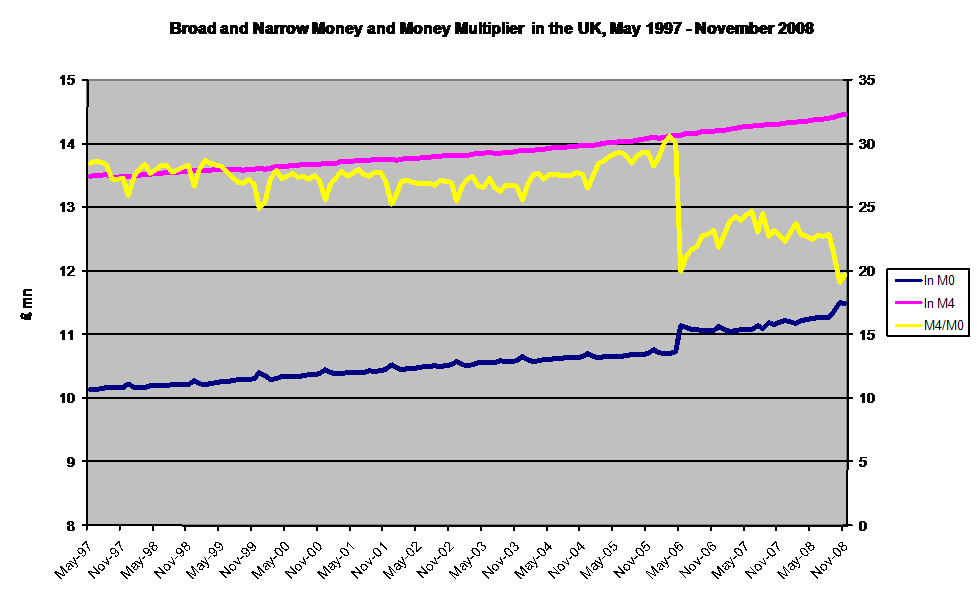
Even without the zero floor on the Bank of England’s official policy rate (Bank Rate) having been reached yet (it currently stands at 1.5 percent), the Bank of England has in fact be printing quite a lot of money. By no means enough in the period since September 2008, I would argue, but certainly quite a bit( TRUE ). This is clear from Charts 1 and 2 below, which show the behaviour of central bank money, also called base money or the monetary base, and its two components, currency (notes and coin held outside the Bank of England) and commercial bank reserves held with the Bank of England. Chart 2 also shows the behaviour of the monetary base, or narrow money, relative to a broad measure of money, M4, which includes sterling bank deposits held by the private sector and some close substitutes. The ratio of broad money to narrow money (here M4 to M0) is sometimes called the (base) money multiplier. Note that in Chart 2, both M0 and M4, but not the ratio of M4 to M0, are drawn on the log scale.

Chart 1

Chart 1

Chart 2

chart-2.gif

Until May 2006, UK monetary policy was unusual in that (a) there were no meaningful reserve requirements for banks (commercial banks only had to hold 0.25% of eligible reserves as non-interest-bearing reserves with the Bank of England under the Cash Ratio Deposit Scheme, an arrangement designed not for monetary policy purposes but to provide the Bank of England with another source of income) and (b) reserves in excess of this minimum required amount were subject to a financial penalty. Excess reserves did not earn interest at all until March 2005. From March 2005 until 18 May 2006 they earned Bank Rate minus 50 basis points. Since May 18, 2006, they earn Bank Rate.

You can see the effect of the May 2006 change in reserve arrangements clearly in Charts 1 and 2. The resulting increase in M0 reflected an increase in the demand for reserves by banks (holding constant everything except the interest rate on reserves). It was therefore not inflationary. The second rapid increase in reserves started in September 2008, when the UK banking system was on the edge of collapsing and, in the US, Lehman Brothers filed for bankruptcy protection on September 15, an event that triggered a state of cardiac arrest in most of the world’s money and capital markets( A CALLING RUN ). Again, this jump upwards in the stock of base money was driven by an increase in liquidity preference by banks. As long as the fear, risk-aversion, and partly irrational despondency that have the banks in their grip persist, the increase in M0 since September 2008 will not be inflationary( TRUE ). It reflects the central bank leveraging up to counteract the otherwise excessively rapid, sudden and destructive deleveraging( CALLING RUN ) of the commercial banks.

When fear and panic eventually desist, however, it is essential that the central bank stand ready to take back the injection of liquidity provided since September 2008( TRUE ). Indeed, as I hope and expect that the Bank of England will, during the rest of this year, engage in ‘printing money’ on a much larger scale than it has thus far( I AGREE ) , the need for an eventual massive contraction in the monetary base when the private financial sector rediscovers its poise and confidence( THAT WHAT THE SOLUTION IS ), will be paramount if the UK is to avoid a major burst of inflation a few years down the road( TRUE ).

How does all this connect with quantitative and qualitative easing? In an earlier post I offered the following definitions:

Quantitative easing is an increase in the size( AMOUNT ) of the balance sheet of the central bank through an increase it is monetary liabilities (base money), holding constant the composition of its assets. Asset composition can be defined as the proportional shares of the different financial instruments held by the central bank in the total value of its assets. An almost equivalent definition would be that quantitative easing is an increase in the size of the balance sheet of the central bank through an increase in its monetary liabilities that holds constant the (average) liquidity and riskiness of its asset portfolio.

Qualitative easing is a shift in the composition( TYPE ) of the assets of the central bank towards less liquid and riskier assets, holding constant the size of the balance sheet (and the official policy rate and the rest of the list of usual suspects). The less liquid and more risky assets can be private securities as well as sovereign or sovereign-guaranteed instruments. All forms of risk, including credit risk (default risk) are included.

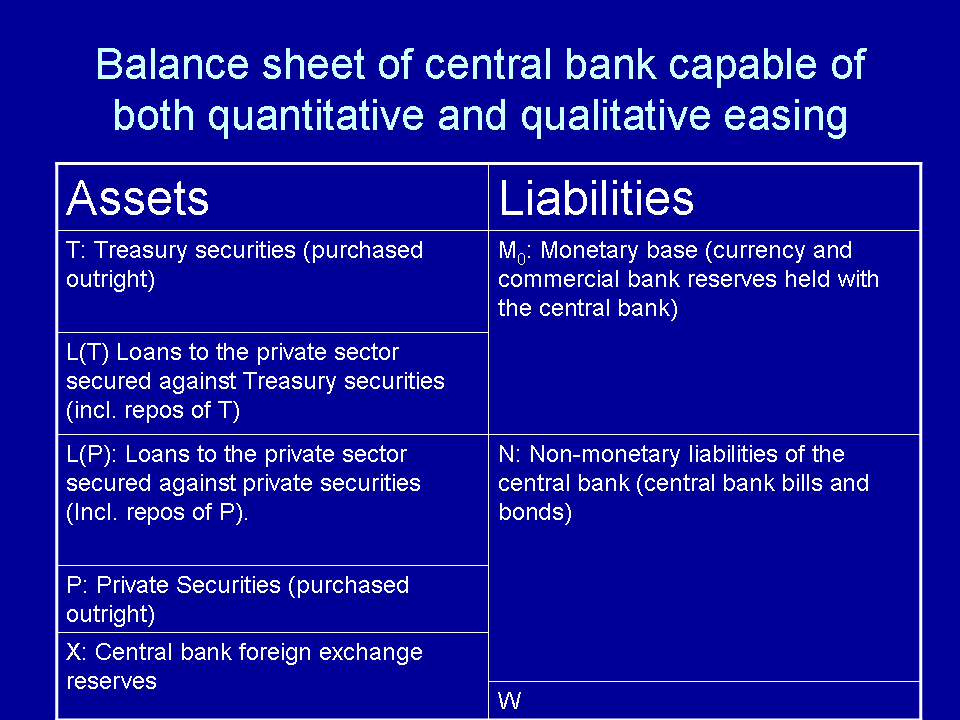
Let me expand on these two concepts with the help of the two central bank balance sheets in Tables 1 and 2.

Table 1
some-comments-on-quantitative-and-qualitative-easing.png

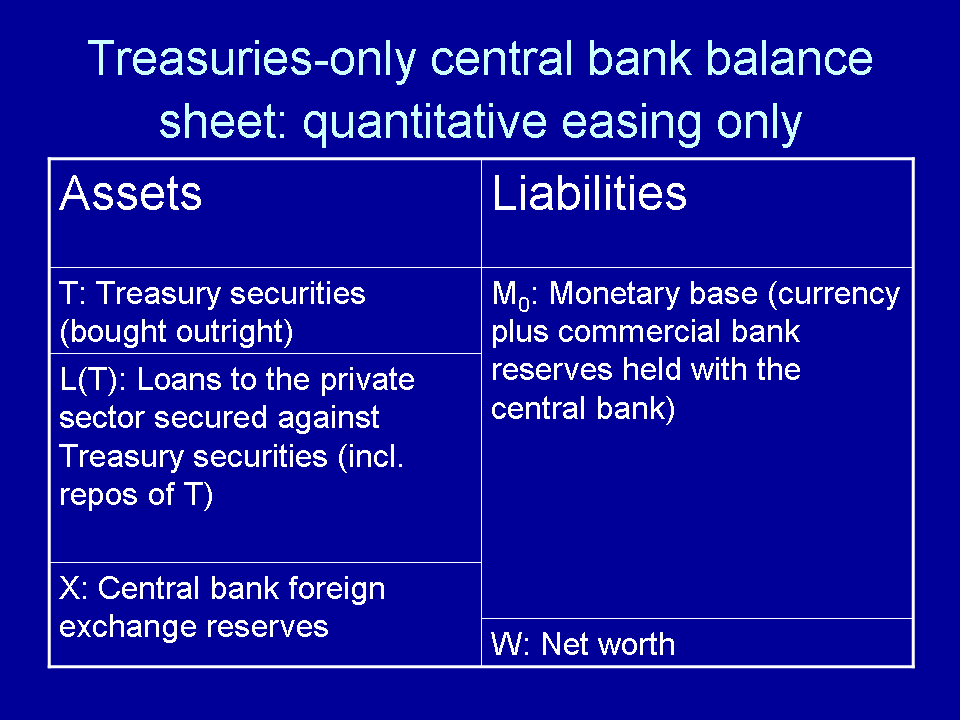
Table 2

table2.png

Table 1 shows the balance sheet of a central bank that today’s besieged central bankers can only dream of. Apart from foreign exchange reserves (X), it has on the asset side of its balance sheet only sovereign debt instruments (T, for Treasury securities) or loans and similar claims on the private sector collateralised against sovereign debt instruments, L(T). On the liability side of its balance sheet it has base money, M0 (currency plus commercial bank reserves) and net worth, W.

This central bank can engage in quantitative easing but not in qualitative easing: even when it lends to the private sector, it requires government securities as collateral, so it engages only in default risk-free lending (more precisely, in lending subject to default risk no greater than the default risk of the sovereign( TRUE )). Quantitative easing would mean expanding the monetary base by buying government securities, or by engaging in an increased volume of lending (or in an increased amount of repos of government debt) to the private sector.

The purpose of the exercise would be, presumably, to lower the interest rate on government securities of maturities longer than overnight. Bank Rate - the official policy rate - sets the risk-free overnight nominal interest rate. Longer-term risk-free nominal interest rates can be influenced by the central bank through two mechanism. The first mechanism is expectations of future official policy rates - of future values of Bank Rate in the UK. If arbitrage is possible on a sufficient scale, confident expectations that the future official policy rate of the central bank over, say, a 3-month horizon, will be equal to its current level, say 1.5 percent, will drive the 3-month risk-free nominal rate to 1.5 percent also. Only the equilibrium risk premia and term premia consistent even with fully efficient financial markets would stand between the expected value of the central bank’s future policy rates over a three month horizon and the 3-month risk-free interest rate (those of you who wonder about a risk-premium with risk-free interest rates should recall that risk is defined in terms of real consumption, or the utility of real consumption, while what the central bank sets is the risk-free nominal interest rate).

In principle, the central bank can, by credibly committing itself to keep the official policy rate at its current level for the next 10 years, bring down the risk-free 1o-year nominal interest rate to something close to the current value of the official policy rate. This does, however, require that arbitrage is possible on a sufficient scale. This is a necessary condition for efficient markets. Events since August 2007 should have convinced even the most foaming-at-the-mouth true believers in the efficiency of financial markets, that they have been worshiping a false god. The idol has feet of clay and has now been toppled so convingly, that the last believers are being whisked away by men in white coats making soothing noises.

So, if expectations and the reality or threat of arbitrage does not drive future risk-free rates down to a suitably weighted average of future expected official policy rates, the central bank can lend the process a hand by purchasing risk-free securities of the relevant maturities whose yields exceed the average expected future official policy rate over the relevant horizon( AS AN INCENTIVE ).

In the US, for instance, quantitative easing is not over until the nominal yield on all government securities of any and each maturity equals zero. But note that quantitative easing can, in principle, occur at any level of the official policy rate. It does not have to wait till the zero floor is reached. At the zero floor, of course, quantitative easing (and qualitative easing) are all the central bank can do.

Any central banker who argues, as some do, that “we set the overnight rate on reserves and we simply accommodate the demand for reserves at that (official policy) rate; therefore, until the official policy rate hits the zero floor there is no quantitative easing as a separate policy instrument” is delirious. This is because the demand for reserves depends not just on the official policy rate, but also on other interest rates and spreads (on public and private assets of different maturitities), some of which can be influenced by the central bank even when the official policy rate is kept constant. This is especially true during times when financial markets are illiquid and disorderly.

When markets are functioning properly, the central bank can really only set one nominal interest rate. When it pegs the risk-free overnight rate, it can influence longer-term risk-free rates only through expectations of its future policy rates( TRUE ). Term premia and default risk premia are not subject to monetary policy influence to any significant degree and liquidity premia are not a major factor. When markets are disorderly and illiquid, the arbitrage required for the expectations hypothesis to do its job cannot take place( MAKES SENSE. NO CLEAR FIGURES. ). There is a term structure of liquidity risk premia that can, in principle, be influenced by central bank liquidity injections (lending) at longer maturities. Liquidity premia and default risk premia are not independent, and central bank policy can even have a material influence on default risk.

All these factors also influence the demand for reserves and the stock of base money. A central bank can accommodate the demand for reserves at its official policy rate and influence that quantity demanded through the effect of its actions on other rates of returns and on market liquity at longer maturities and for a wide range of financial instruments.

Today’s central banks are, however, operating with a balance sheet more like the one shown in Table 2. The key difference is that on its asset side, the central bank now lends to banks (and perhaps to other private entities) against private collateral as well as against sovereign debt instruments; L(P) includes repos of private securities. The Bank of England was a late convert to this, but does now accept private debt instruments in repos and collateralised lending. The ECB always did, and so did the Fed, although it got out of the habit before August 2007.

In addition, the central bank can purchase private securities outright. This is the item P on the asset side of the balance sheet. The Fed does this on quite a large scale now, when it began to purchase commercial paper (CP) and Asset-Backed Commercial Paper (ABCP). If central banks make unsecured loans to private banks or other private sector entities, that too would be part of P.

The Fed’s proposed outright purchases of mortgage backed-securities issued or guaranteed by Fannie Mae, Freddie Mac and Ginnie Mae do not fall into this category, as Ginnie Mae is a government agency and both Fannie and Freddie are 100 percent government-owned( BUT ONLY IMPLICITLY GUARANTEED ). It is just a tiny bit silly to have one state entity (the Fed) acquire debt instruments issued or guaranteed by another state entity or state-owned entity. Much easier to slap a Federal guarantee directly on all these mortgage-backed instruments and leave the Fed to do monetary policy( I AGREE COMPLETELY ). But that would be too fiscally transparent and too easy( I AGREE ). Neither the Bank of England nor the ECB have thus far acquired private securities outright or lent unsecured to the private sector.

There is also a potential addition on the liability side of the central bank’s balance sheet. Central banks can issue non-monetary liabilities, instruments effectively the same as Treasury Bills or Treasury Bonds - let’s call them central bank bills and central bank bonds. In many developing countries and emerging markets this is a common practice. Quite often the credit of the central bank is better than that of the government, and open market operations are conducted entirely through the purchase and sale of central bank bonds and bills. We may see this emerging market phenomenon in the the submerging market economies of the West before long.

The balance sheet of Table 2 permits us to discuss various ways of implementing qualitative easing, and combinations of quantitative and qualitative easing.

Qualitative easing means the central bank either making loans to the private sector that are not collateralised against sovereign debt instrument (L(P) increases) , or lending unsecured to the private sector or purchasing private securities outright (P increases), but without changing the quantity of base money ((M0) is constant). This means that these loans or purchases are either financed by the central bank selling sovereign debt instruments it holds (T falls), or by the central bank reducing the amount of lending secured against sovereign debt instruments (L(T) falls) , or the central bank increasing its issuance of central bank bills and bonds (N increases).

By expanding its acquisition of private instruments or by lending to the private sector either unsecured or secured against private collateral, the central bank can directly target the spreads of these private debt instruments and private lending over the expected average future official policy rate (as measured, say, by the OIS rate - the Overnight Indexed Swap rate). Clearly, even in fully efficient markets these spreads will be non-zero because of equilibrium term premia, equilibrium inflation risk premia and equilibrium default risk or credit risk premia. But the liquidity risk premia, and the fear-and-panic premia could be much reduced or even eliminated.( I AGREE )

So I expect that our central banks will do quite a bit more quantitative and qualitative easing - expanding the size of their balance sheets, mainly by increasing the monetary base on the liability side, that is, by printing money, and on the asset side by increasing lending to the private sector secured against private securities (or unsecured) and increasing outright purchases of private securities.

The Fed is doing so already, and with gusto. It can do so without fear for its balance sheet, despite taking on a lot of private credit risk (default risk), because the Treasury explicitly guarantees the Fed’s outright purchases of private securities and other non-standard taking on of private default risk.

The Bank of England already has some credit risk on its balance sheet, through its repos of private securities. It has therefore engaged in qualitative easing. The sharp increase in the size of its monetary liabilities since September 2008 is evidence of considerable quantitative easing also. I expect it to increase the scale of its rediscounting of private securities and its repoing of private instruments during the coming year and beyond, until this crisis is over. I also expect it may have to lend outright and unsecured to banks and other private agents and that it will buy private securities outright and in volume before this is over.

Quantitative easing, through the acquisition of Treasury securities or through increased repos of Treasury securities and matching expansion of the monetary base, should be none of the Treasury’s business - it remains the province of the Monetary Policy Committee of the Bank of England. This is because the Bank of England does not take on any additonal credit risk other than that of the sovereign itself through these operations.

Qualitative easing or a combination of qualitative and quantitative easing does increase the credit risk the central bank is exposed to. Conceivably, the central bank could suffer a capital loss on its exposure to private securities that would be so large, that it could only restore its solvency without external assistance through monetary issuance of a magnitude that would threaten its price stability mandate( TRUE ). Indeed, if the exposure of the central bank were to foreign-currency-denominated securities, it might not be able to salvage its solvency through any amount of domestic currency issuance. In both these cases, the central bank (or its inflation mandate) would have to be rescued by the tax payer, through a non-inflationary recapitalisation by the Treasury. This means that qualitative easing, or any combination of qualitative and quantitative easing that increases the credit risk on the central bank’s balance sheet, should require the consent of the Treasury, and cannot be decided by the central bank alone( A GOOD POINT ).

I believe it would be best, operationally and to preserve central bank operational independence over monetary policy, if the Treasury were to set an upper limit to the amount of credit risk (by some metric) the central bank can take on, with the central bank being given the discretion to manage the composition and size of its balance sheet up to that limit.( A GOOD POINT )

Today, central banks and Treasuries appear to be conspiring to hide from the public the magnitude of the credit risk exposure they are taking on. In the UK, for instance, the SLS (the special liquidity scheme that swaps private securities like mortgage- backed securiteis for Treasury bills of less than one year maturity) is, as far as I can tell, neither on the balance sheet of the Bank of England nor on that of the Treasury. The Bank of England manages the facility as agent of the government, but does not carry the credit risk. Since the Treasury bills are of less than one year maturity, they are, for some obscure accounting reason, not counted as public debt in the UK. So I doubt they are recorded as Treasury liabilities - which of course they are. The assets, of course, are not counted either, but the liabilities are known and certain while the assets are illiquid, of unknown value and quite possibly dodgy( TRUE ). Accountability for the use of public resources is the first victim of a financial crisis( YES ).

I expect that we will see all three central bank, the Fed, the ECB and the Bank of England, continue to engage in qualitative and quantitative easing, expanding the size of their monetary liabilities (’printing money’) to finance acquisitions of private securities and to increase the scale and scope of lending to the private sector, both unsecured and secured against private securities. The Fed clearly has the bit between its teeth and is hot to trot further and farther. The Bank of England has not yet engaged in either unsecured lending to the private sector on in outright purchases of private securities, but I anticipate we will see both types of interventions before long.

The ECB/Eurosystem is the most interesting case. It has historically repoed against a wider range of private securities that the other two central banks, and it accepts a similarly broad range of private securities as collateral at its discount window - the marginal lending facility.

It is also, however, the central bank that appears to be most anxious about credit risk on its balance sheet. And one can appreciate the reason for that. Who, after all, backs the ECB/Eurosystem fiscally? The US Department of the Treasury backs the Fed. HM Treasury backs the Bank of England. Do the national Treasuries of the 16 member states that make up the Eurozone back the ECB/Eurosystem if it needs aggregate recapitalisation? Do the national Treasuries of the 27 EU member states whose national central banks (NCBs) are the shareholders of the ECB back the ECB/Eurosystem fiscally? There is a sharing rule among the 16 NCBs that, together with the ECB, make up the Eurosystem. But this sharing rule concerns only the sharing of losses incurred in the conduct of the common monetary and liquidity management policy. It does not change the total amount of capital of the Eurosystem, only its distribution.

This glaring hole in the construction of the ECB/Eurosystem - the absence of a clear, credible fiscal back-up for the ECB/Eurosystem - must be plugged forthwith. The long-term solution is an independent supranational Eurozone fiscal authority with independent tax and borrowing powers. The interim solution is a Fund of, say, €3 trillion, created by the governments of the Eurozone member states, that can be accessed, with the consent of a qualified majority of the Eurogroup member states, to recapitalise the ECB/Eurosystem, should its capital be depleted to the point that its ability to fulfill its price stability mandate is under threat. This Eurofund fund could be administered by the European Commission, or even by the European Investment Bank. The 16 Eurozone governments could seed the Eurofund with national sovereign debt, in proportion to their countries’ share of the ECB’s existing capital (normalised by the share of the Eurozone member states in the total capital of the ECB). Alternatively, the Eurofund could issue Eurozone debt instruments (Eurozone Bonds) guaranteed jointly and severally by the Eurozone national governments. During normal times, the profits from the Eurofund would be paid out to the governments providing the guarantees. If the guarantee is joint and several, the Eurofund should be able to borrow more cheaply than the most creditworthy national government, provided national sovereign defaults are not perfectly positively correlated).

Without a credible fiscal back-up for the ECB/Eurosystem, there is a material risk that the current crisis will expose the limitations of a central bank construction that does not underpin the ability of the central bank to act as market maker of last resort( LOLR ) with appropriate contingent fiscal support mechanism.

Let me be clear: there is no potential problem when a Eurozone NCB assists a private bank in its jurisdiction in a specific lender-of-last-resort operation. According to the Treaty, the NCB in question can only provide any financial support of this kind after the national Treasury involved has provided a comprehensive commitment to indemnify that NCB for any losses involved as a result of the lender-of-last-resort-operation. The problem arises when, as a result of ‘normal’ monetary policy or liquidity operations, the NCB (or even the ECB itself, were it to engage in such operations directly) incurs exposure to credit risk. The NCBs of the Eurosystem do so routinely. In the past, the credit risk involved - the probability of a joint default of the bank borrowing from the NCB and of the issuer of the collateral - was deemed small. That is no longer a safe assumption to make even in the case of repos of private securities. It certainly is not a safe assumption to make were the ECB to engage in unsecured lending or in direct purchases of private securities.

Unless a way is found soon to plug the fiscal black hole behind the ECB/Eurosystem, the ECB/Eurosystem may either have to take on excessive credit risk or it may have no choice but to abstain from participation in the next stage of quantitative and qualitative easing: direct unsecured lending by the central bank to the private sector and direct purchases of private securities by the central bank."

Monday, January 5, 2009

"If not read carefully, one might assume that the Fed is not engaging in a policy of quantitative easing, when in fact, it is."

Rebecca Wilder on News N Economics makes some sense about the issue of whether or not the Fed is engaging in Quantitative Easing:

"The Fed's message: We're not the Bank of Japan

The Fed is increasingly discussing its monetary policy goals, and it’s about time( I AGREE ). But I have noticed that the Fed is being very careful not to use the term quantitative easing (QE) when describing its current policy measures. If not read carefully, one might assume that the Fed is not engaging in a policy of quantitative easing, when in fact, it is. ( I AGREE. IF IT ISN'T, IT'S A KIND OF PRELUDE OR OVERTURE. )

What the Fed is trying to say is this: we are pursuing a QE policy, but differently than did the Bank of Japan earlier in the decade because; we are not growing the liabilities side of our balance sheet. This seems little silly, as the Fed may very well start printing currency if prices continue to decline. Note: See this post for a discussion of quantitative easing, the Fed’s creation of reserve balances, and the “printing of money.”

The Fed finally stated its intentions

1. The Fed had its big coming-out monetary policy party when it announced a near-zero interest rate policy on December 16. Before that, one could only speculate as to what the Fed’s intentions really were. In the Fed’s announcement of its intentions to use any means necessary to promote economic growth and price stability, the word quantitative was not used, except to refer to the purchase of “large quantities of agency debt and mortgage-backed securities to provide support to the mortgage and housing markets”. No mention of quantitative easing, when in fact, that is exactly what the Fed is doing.

2. In a press conference directly following the Fed’s announcement, the Wall Street Journal reported:

But the senior Fed official said the central bank’s approach is distinct from quantitative easing and different from what the Japanese did. The Fed’s balance sheet has two sides, the official explained: assets with securities the Fed holds (including loans, credit facilities, mortgage-backed securities) and liabilities (cash and bank reserves). Japan’s quantitative easing program focused on the liability side, expanding cash in the system and excess reserves by a large amount. The Fed’s focus, however, is on the asset side through mortgage-backed securities, agency debt, the commercial paper program, the loan auctions and swaps with foreign central banks. That’s designed to improve credit-market functioning, the official said. By expanding the balance sheet by making loans, the official explained, the focus is not on excess reserves but on the asset side. That securities-lending approach directly affects credit spreads, which is the problem today — unlike Japan earlier, where the problem was the level of interest rates in general, the official said.
3. And then Janet Yellen, President of the Federal Reserve Bank of San Francisco, said this (hat tip, Mark Thoma):
On the surface, it may seem appropriate to equate the Fed's use of its balance sheet to stimulate the economy with the quantitative easing policy pursued earlier by the Bank of Japan. But as I noted at the outset, the differences outweigh the similarities in my opinion. The main similarity is that the Fed, like the Bank of Japan, has increased the quantity of excess reserves in the banking system well above the minimum level required to push overnight interbank lending rates to the vicinity of zero. The creation of such a large volume of excess reserves, in the Fed's case, results from the enormous expansion in the Fed's discount window lending, foreign exchange swaps, and asset purchases. In the Bank of Japan's case, the expansion in excess reserves resulted from the deliberate adoption of an explicit numerical target for them. The theory underlying the Bank of Japan's intervention was that banks might be encouraged to lend by replacing their holdings of short-term government securities with excess cash.
The Fed is pitching the same line: our policy is different from the Bank of Japan’s (BoJ) policy measures earlier in the decade. Janet Yellen went as far as to imply that the Fed is not engaging in a QE policy. But Bernanke himself defines QE as “providing bank reserves at levels much greater than needed to maintain a policy rate of zero” (page 5 of Bernanke, Reinhart, and Sack), whichis exactly what the Fed is doing.

The Fed IS engaging in QE policy, but somewhat differently than did the Bank of Japan.

Like the BoJ, the Fed is growing its balance sheet through reserve creation. The Fed has been quite explicit about this, citing the funding of the MBS purchase program and GSE debt through reserve creation.

This should be a familiar chart by now. It illustrates the Fed’s various lending policies listed in its balance sheet. The Fed has increased the credit extended to the commercial banking system by $1.35 trillion in just one year, mostly through the creation of reserves.

The Bank of Japan targeted commercial bank reserves – through the printing of currency and creation of reserves – to a level of 30-35 trillion yen. The Fed has made no such target.

Unlike the BoJ, the Fed's liabilities are falling.

The chart illustrates the liabilities side of the Fed balance sheet. As you can see, with the unwinding of the TSP account (see this post ), the liabilities of the Fed are falling rather than rising. And furthermore, the Fed is not growing its currency stock in bulk. The BoJ’s liabilities would have been rising precipitously, as it flooded the banking system with yen (printing currency).

So the Fed isn't printing hard currency. I find this to be a rather mute point, as the Fed would probably like to see a little inflation right about now. James Hamilton argues that the Fed should consider increasing bank cash holdings to create some inflation. Inflation would lower the real debt burden of households and firms, ensuring that debts at least could be paid off. In the Wall Street Journal, Kenneth Rogoff argues: that "a little inflation would be a good thing".( I AGREE )

The Fed said that it will “employ all available tools to promote the resumption of sustainable economic growth and to preserve price stability"; that certainly doesn’t preclude the printing of currency. I wouldn’t be surprised if the Fed started to print currency soon (it has already increased the currency stock by $44.5 billion since October 8) to promote a little inflation.

Rebecca Wilder"