Showing posts with label Stop The War In North Kivu. Show all posts

Friday, March 20, 2009

We are getting increasing reports of FDLR targeting civilians they accuse of collaborating.

TO BE NOTED: From Stop The War In North Kivu:

"
Negative hornets
2009 March 20

We are getting increasing reports of FDLR targeting civilians they accuse of collaborating. We’re seeing increased instances of rape and killings of civilians“(…) “A hornets’ nest has been stirred up, and I’m not sure that anyone is prepared to deal with the angry hornets.”

Anneke Van Woudenberg (HRW) recently said this regarding the “counter attack” of FDLR forces in the Kivus after the departure of the Rwandan Armed Forces at the end of February.

I agree with this opinion. The metaphor, though, is a dangerous one. I find picturing the FDLR as a “hornest´nest” pretty close to a term well-known in the region: that of “negative forces”.

As in any other war, language in the Great Lakes Region is a tool of propaganda. For years, one of the biggest propaganda successes of the Rwandan regime was coining the term “negative forces” referring to FDLR. Almost everyone used it for a while. By using it, everything regarding this group became instantly bad. However, many historians and analysts have shown that the degree of revengeful violence inflicted in the Kivus by the Rwandan Armed Forces was comparable to the unbearable suffering Rwanda went through in 1994. This to say: there is not one single “negative force” in this affair, but many. One side, though, has been able to present itself as a pure and simple victim for a long time. That is part of the truth (a painful truth that has to be remembered and never forgotten), but not the whole of it.

There are no memorials for the people that were slaughtered at the other side of the border, in Congolese soil. And they were many."

Sunday, February 22, 2009

But the DRC rarely appears in the main tabloids

From Stop The War In North Kivu:

"
How many people have to die in the DRC to appear in the New York Times?
2009 February 22
by Blog admin

drc-isrpal

Stealth Conflicts suggests this is the death toll comparison between the conflict in the DRC and the Palestine-Israeli conflict. I am sure that this estimation (based on known figures) is very close to the real figure.

We live in a globalized world, where any information shows up on a webpage in a matter of minutes. But the DRC rarely appears in the main tabloids. With its absence, the media are sending us a message: depending on where you are born, your life is worth more, or less.

This is so evidently unfair and painful.

My only hope is that, forty years from now, this scandal will be seen as a problem of the past. As a symptom of the problems of a society -our developed one- that, with time, changed for better. I hope to talk about it to my grandsons in the same way afroamerican grandparents talk nowadays about Rosa Parks. Like talking about an evident problem that finally, one day, one person dared to face. And changed for good.

We need our own Rosa Parks to raise this issue. I hope she will come soon.

Me:

I agree with you. The DNC, Uganda, Nigeria,etc., have all had more casualties that the Israeli-Palestinian Conflict. In my opinion, we should be invested in ending all wars, but especially focused on where the most people are dying.

I’m Jewish, so I’m going to give my take on why this is the case:
1) Israel is involved in the West vs Islam theme
2) Oil producing countries are tangentially involved
3) Jew Hatred
4) Disinterest/ Bigotry: However, this applies to Columbia, Sri Lanka, Etc. Not just Africa.

The Israeli-Palestinian conflict is the only one in the world where everybody on earth, now matter how bigoted or ignorant of the actual circumstances, has an opinion. For me, and I know this sounds strange to Non-Jews, the hatred of Jews plays a huge role in the focus. A lot of anti-Israel criticism is just Jew Hatred. If you want my views on the conflict, they’re on my blog. After all, one wonders how Gaza, which I was against and needs to be assessed for war crimes on Israel’s part, as does Hamas, can be genocide, when Nigeria, where 10,000 people have died in recent years, doesn’t even rate a comment.

My focus on the DRC is partly political, but also religious. Everyone is equal. Ignoring the slaughter of people for any reason, but especially ethnic reasons, is something that offends and concerns me deeply as a person and a Jew.

Keep up the good work.

Saturday, February 21, 2009

The problem is: if Rwandan armed forces really leave, how are the FARDC suppose to hold their current position in the front line?

From Stop The War In North Kivu:

"
US: “Real success in the Kivus”. Sure?
2009 February 21

Through words of its ambassador in the DRC, the US have publicly shown their full support for the joint military operation taking place in the Kivus. This kind of open declaration, and the way things are happening, can let us even think that plan the itself has been conceived by US diplomacy and proposed to Kigali and Kabila with a “you take it, or you take it” approach, soften with the idea of a “win-win” situation for everyone.

It seems that once the US speaks, the EU feels that it has to express itself on the matter.

Eurac, an influential European advocacy network, has expressed interesting recommendations on the current scenario, mainly advocating for less military muscle and more negotiation. This is not an easy thing to say now, though, because we are knowing that the FDLR keeps on killing civilians. However, let´s make this clear: the FDLR are not the only negative forces in this war, no matter how many times Rwanda has tried to label them with this term. All armed groups involved in this war are more than negative (Filip Reytnjens expressed the spiral of violence in the Great Lakes region after the genocide with a very lucid sentence: “this is not a story of good guys fighting bad guys. This a story of bad guys”).

Following the on-going diplomatic plan, Rwanda affirmed yesterday what most Congolese citizens wanted to hear: that Rwandan troops will leave the country this same week. “Tomorrow [for today] they are going to issue (the orders). They will begin pulling back slowly,” a Rwandan spokesman said yesterday. He said that the withdrawal will be completed for next Wednesday.

The problem is: if Rwandan armed forces really leave, how are the FARDC suppose to hold their current position in the front line?

Many people in this part of the world remember the last time Rwandan forces left the Kivus. An expression was coined that time. People said that Rwandan soldiers “left through the main entrance and came back through the back window“. This is to say, they continued their presence in Congolese soil in a more disguised, but real, way. Many Congolese fear this could be the case again.

Me:

To tell you how strange reporting in the US is, I'm going to post you a post I submitted to the NY Times today which was rejected. It was on the Bob Herbert column:

The war in the DRC and the recent rampage of the Lord's Resistance Army are not invisible if you care to look. Here are a few resources:

http://af.reuters.com...

http://stopthewarinnorthkivu.wordpress.com...

http://blogs.lesoir.be/colette-braeckman/

http://petereichstaedt.blogspot.com/

Recently, the US was involved in pressuring Rwanda to intervene with the cooperation of the DRC in the DRC, and in helping Uganda search for the LRA, which turned into a nightmare for many because the search was poorly organized.So the US is involved, although more needs to be done. The UN's role is not what it should be. Here is a very good essay on the UN in the DRC:

http://www.grip.org...

Don the libertarian Democrat

— Don, Tacoma, WA

So I'm trying to publicize places where one can keep up on the crisis, but it's not easy. I've no idea if the problem was mentioning other blogs or using French sources. Je ne comprend pas. I didn't look that up. It might not be correct. I'm much better at reading French.

Friday, February 13, 2009

if the local population collaborated with the Rwandan army they would be considered the FDLR’s “mortal enemy” and treated as a “belligerent party.”

From Stop The War In North Kivu:

"
HRW: Rwandan Rebels Slaughter Over 100 Civilians In News on February 13, 2009 at 3:21 pm

HRW informs today that the FDLR slaughtered at least 100 Congolese civilians in the Kivus between January 20 and February 8, 2009.

In Remeka village in Ufamandu, the FDLR rebels called a meeting at which they accused the population, local leaders and the Mai Mai armed group with whom they had been allied, of having betrayed them. A local resident present at the meeting said the FDLR told residents they would not be allowed to leave and that they were “sharpening their spears and machetes.” Another said, “The FDLR told us that if they were shot at by anyone that they would hold us responsible and kill us.”

Following the meeting, the FDLR erected barriers to prevent people from fleeing. When some tried to flee, the FDLR attacked them, killing dozens with guns, rocket-propelled grenades, and machetes. “As I ran, I saw bodies everywhere - men, women and children,” said one witness. “They had all been killed by the FDLR.”

FDLR combatants also raped more than a dozen women whom they accused of having joined the government side against them. For instance, in southern Masisi territory (North Kivu), on January 27, FDLR combatants raped and killed a woman and then raped her 9-year-old daughter.

The message given at the Remeka meeting was repeated in a letter sent from the FDLR to the governor of South Kivu in early February. In the letter, the group warned that if the local population collaborated with the Rwandan army they would be considered the FDLR’s “mortal enemy” and treated as a “belligerent party.”

Read the full text here.


Me:

  1. So, let me see: The UN won’t work, joint Rwandan/DRC actions won’t work, all sides commit war crimes. Can we at least find out what’s really going on?

    Your comment is awaiting moderation.

Thursday, February 5, 2009

five Member States have agreed to send the required intelligence experts to MONUC, albeit without providing the necessary equipment.

From Stop The War In North Kivu:

"
The blue helmets asked will never come In Uncategorized on February 4, 2009 at 9:20 am

Source: United Nations Security Council

Date: 27 Jan 2009

Letter dated 27 January 2009 from the Secretary-General addressed to the President of the Security Council (S/2009/52)

I have the honour to refer to the additional capacities for the United Nations Organization Mission in the Democratic Republic of the Congo (MONUC) which the Security Council authorized by its resolution 1843 (2008 ) of 20 November 2008 and which it recalled in its resolution 1856 (2008 ) of 22 December 2008.

I regret to inform you that, despite the Organization’s considerable efforts to generate the additional resources required, in particular through consultations in New York and in a number of capitals, troop-contributing countries have not been as receptive as we had hoped. In all, 49 troop contributors and 12 potential troop contributors have been asked to provide the Mission with the additional troops and resources authorized. The need for robust and highly mobile troops was particularly emphasized. Four countries that are contributing police personnel have also been approached.

The United Nations accepted an official proposal from Bangladesh to provide one infantry battalion, one engineer company and one formed police unit, as well as a proposal from Belgium to provide a C-130 aircraft to the Mission. In addition, five Member States have agreed to send the required intelligence experts to MONUC, albeit without providing the necessary equipment.

Four Member States have expressed interest in providing the second authorized battalion, while two others might provide the two special forces companies. Another Member State indicated that it might be able to provide the second formed police unit. Finally, I received a letter from the Economic Community of Central African States indicating that its member countries were willing to provide certain capacities to the Mission. The Secretariat will continue to assess the expressions of interest that most closely match the Mission’s resource requirements. While these expressions of interest are positive, I nevertheless have some concerns to communicate to the Security Council. More than two months after the adoption of resolution 1843 (2008), no formal offers have been made in response to these requests. I am especially concerned about the lack of formal offers of special forces companies.

Equally worrisome is the fact that there have been no commitments or expressions of interest regarding the remaining air assets (one C-130 and 18 utility helicopters) or the deployment of the 200 military training instructors/advisers needed. These resources are essential for the Mission’s mobility and rapid reaction capacity, which are vital if it is to fulfil the mandate set out by the Security Council.

Given the need to deploy the additional resources authorized for MONUC as soon as possible, I would like to renew my appeal to those troop- and policecontributing countries that have the necessary capacities to enable the Mission to discharge its mandate effectively, pursuant to resolution 1856 (2008). I will keep the Security Council regularly informed of the efforts made in this regard.

In the meantime, any efforts by the Security Council to encourage troopcontributing countries to provide the Mission with the necessary resources would be greatly appreciated."


Me:

You know, these blue helmets aren’t exactly getting a lot of good press. They’re either accused of aiding one side or doing nothing. It would help if we could get an idea of what and how well they’re doing in North Kivu. MONUC seems impotent from the outside.

And:

Hi Don,

They actually are doing very little, in spite of the cost of the mission (1 billion dollars per year). The people in Goma do not like them. They feel that the blue helmets do not do enough to protect them. In too many occasions (Kiwanja was one of the last ones) civilians were killed and the blue helmets did not intervene. If you are interested, this is one of the best reports I´ve found about the UN mission in the DRC (in French, sorry: http://www.grip.org/fr/siteweb/dev.asp?N=simple&O=625)

Monday, January 26, 2009

Nkunda, once Rwanda's tool in keeping Hutu militias at bay, had become an embarrassment.

From Stop The War In North Kivu, some context:

"
Diplomatic pressure and unknown deals In Analysis, News on January 25, 2009 at 3:43 pm

Last Friday, Chris McGreal provided a very comprehensive analysis of the recent events in The Guardian. Together with Foreign Policy, the Guardian points to diplomatic pressure pushing the deal, specially after Kiwanja and the Stearns report:

Kagame’s closest allies overseas, the US and Britain( ABOUT TIME ), which provide the bulk of Rwanda’s foreign aid and a lot of diplomatic cover, quietly made clear that the conflict in eastern Congo had to be brought to an end.

However, as Jason Stearns said last Friday on the NYT, Nkunda’s arrest is part of a broader realignment. As he underlines, the unknowns and risks over the horizon are many."

Here's the Guardian:

Rwanda: why former military hero was disowned after rampages in Congo
The arrest of Laurent Nkunda reflects a dramatic diplomatic shift after tiny but ambitious state found itself on receiving end of international criticism
Laurent Nkunda

Laurent Nkunda: had become an embarrassment to Kigali Photograph: AP

Tony Blair happened to be in Rwanda at the time the Tutsi rebel general, Laurent Nkunda, was slaughtering his way through eastern Congo late last year.

Blair – who has taken on saving Rwanda as another of his post-premiership missions, inserting people into the offices of the president, prime minister and cabinet in Kigali to help run the government – was keen to talk up the prospects for the tiny central African nation that has made remarkable strides since the 1994 genocide that left about 800,000( 800,000 ) Tutsis dead.

But the world's attention was on a different aspect of Rwanda entirely. This time Rwanda was on the receiving end of international criticism for backing Nkunda amid the continuing horror of massacres, mass rape and perpetual refugees in Congo, where about 5 million( 5 Million ) have died as the result of more than a decade of war and its effects.

Nkunda, once Rwanda's tool in keeping Hutu militias at bay, had become an embarrassment. The rebel general had already spilled a lot of blood before the crisis flared again last October when his forces marched to the edge of Goma in eastern Congo. But on that occasion the world, for once, took notice when Nkunda's men went through the town of Kiwanja systematically killing hundreds of the remaining men, and some families.

In Rwanda President Paul Kagame's government was alarmed. His minority Tutsi-led administration, which drew much of its foreign support from the moral authority of having ended the genocide, was now seen more as perpetrator than victim.

Kagame's grand scheme to project his country as a rapidly modernising state embracing Anglo-Saxon liberal capitalism – even to the extent of switching the education system from French to English( WOW. OF COURSE, HE'S PROBABLY NOT FOND OF THE FRENCH. ) – was threatened by its support of Nkunda. Its involvement in Congo sent out the message that Rwanda was really run by another bunch of bloodthirsty warlords.

At that point Nkunda became more of a liability than an asset. His arrest yesterday, as he fled into Rwanda with large amounts of cash, gold and diamonds( HOW NICE ), is one part of a dramatic diplomatic shift as Kigali tries to detach itself from direct involvement in Congo that used to pay dividends in securing its frontier and vast profits from the plunder of minerals but which has become a political burden.

Nkunda's close ties to Rwanda go back to his days fighting in the rebel army, the Rwandan Patriotic Front (RPF), that overthrew the genocidal regime and took power in 1994. He returned to Congo – or Zaire as it then was – and was again drawn in to collaboration with the RPF after it invaded Congo twice in the second half of the 1990s to fight the Hutu militias that had fled there after leading the genocide.

After Rwanda pulled out of Congo in 2003, it saw Nkunda's National Congress for the Defence of the People (CNDP) as a buffer force against the Hutu force, the Democratic Front for the Liberation of Rwanda (FDLR), which had gained control of swaths of territory on Rwanda's border and kept up the mantra of genocide, threatening to exterminate Tutsis.

But Nkunda, in the name of defending Tutsis, was increasingly bloodthirsty. His forces rampaged through cities such as Bukavu, murdering and raping. They also got into the mining business, getting rich out of plundering gold, diamonds and coltan, a crucial but rare component of mobile phones.

Much of the world turned a blind eye to Rwanda's backing for Nkunda. Officially it had stopped because Kigali was embarrassed by his excesses but there was no doubt that links remained. Nkunda's soldiers included English-speaking Tutsis most likely drawn from Rwandan exiles who grew up in Uganda. The UN observed weapons being shipped through a triangle of land that linked Rwanda, Uganda and Congo. Above all, for a long time Nkunda served Rwanda's interests and Kigali declined to condemn him.

No more. Rwanda is trying to reshape itself as a modern, forward-looking country, far from the semi-fascist state that took hold during the three decades from independence to the genocide. The government's successes can be seen in how the capital has boomed since the genocide. Millions of dollars flowed in to build new hotels now filled with tourists and conferences. Kagame is talking up his country's prospects as a regional information technology hub.

But Congo increasingly threatened to wreck the new image, and Nkunda – who, as he grew more powerful, took to greeting visitors to his hilltop headquarters dressed in flowing white robes, like some messianic figure, with his white pet goat in tow – went from being an asset to a problem.

The political capital that the minority Tutsi-led government of Rwanda could draw on because of western guilt and sympathy after the genocide was increasingly overshadowed by the crimes being committed in Congo.

In December a UN report accused the Rwandan government of fuelling the conflict through covert support to Nkunda. The report also accused the Congolese government of ties to the Hutu militias threatening Rwanda, but that attracted less attention.

Rwanda vigorously denied the accusations but they were well documented and a further embarrassment after the crimes of Nkunda's forces a few weeks earlier. In response, some European governments cut off aid to Rwanda, emphasising to Kigali that it was now no longer viewed as the victim.

Kagame's closest allies overseas, the US and Britain, which provide the bulk of Rwanda's foreign aid and a lot of diplomatic cover, quietly made clear that the conflict in eastern Congo had to be brought to an end.( AT LAST )

Last week saw two dramatic and complementary developments. Nkunda faced a revolt within the CNDP, with some of his officers saying they had removed him from command and would no longer fight the Congolese government. At the same time, thousands of Rwandan troops moved across the border in agreement with the Congolese government to purse the Hutu militias controlling swaths of territory.

The deal was in place. Rwanda would neutralise Nkunda and the CNDP so long as the Hutu militias were also confronted. Tellingly, the rebel general fled across the border after he was confronted by a joint Rwanda-Congolese force. Nkunda's benefactor was allied with his enemy in pursuit of him.

Eastern Congo has been here before, and there is unlikely to be a complete halt to the violence for some time. There are still too many armed groups and mining groups with a vested interest in continued instability.

But dealing with the Hutu militia and Nkunda does confront the root causes of the conflict in eastern Congo for the first time, and gives its long suffering people the prospect of hope they have not had for many years."( GOOD )

From the NY Times:

A Congolese Rebel Leader Who Once Seemed Untouchable Is Caught

Uriel Sinai/Getty Images

Gen. Laurent Nkunda, shown in November 2008, was apprehended late Thursday by Rwandan troops. Rwandan authorities on Friday were tight-lipped about what they would do with him.

Published: January 23, 2009

KIGALI, Rwanda — Overnight, the battle in Congo has suddenly shifted.

Skip to next paragraph
Benedicte Kurzen/VII Mentor

Gen. Laurent Nkunda, the leader of a group of rebels, with his pet goat Betty in the mountains of Congo in November.

Benedicte Kurzen/VII Mentor

Mr. Nkunda at a training camp in North Kivu Province for the group of rebels that he leads.

General Nkunda was cornered near Bunagana.

Gen. Laurent Nkunda, the Congolese rebel leader whose brutal tactics and Congo-size ambitions have threatened to bring about another catastrophic war in central Africa, was arrested late Thursday, removing an explosive factor from the regional equation.

According to United Nations officials and Rwandan authorities, General Nkunda was captured by Rwandan troops as he tried to escape a Congolese-Rwandan offensive that has taken aim at several rebel groups terrorizing eastern Congo.

General Nkunda had seemed untouchable, commanding a hardened rebel force that routinely humiliated Congolese troops and then calmly gliding through muddy villages in impossibly white robes. But he may never have anticipated that his old ally, the Rwandan Army, would take him away.

The surprise arrest could be a major turning point for Congo, which has been mired in rebellion and bloodshed for much of the past decade. It instantly strengthens the hand of the Congolese government, militarily and politically, right when the government seemed about to implode. But it could also empower other, even more brutal rebel figures like Jean Bosco Ntaganda, General Nkunda’s former chief of staff, who is wanted by the International Criminal Court in The Hague for war crimes.

Still, analysts and politicians say they hope that General Nkunda’s capture at the hands of Rwanda means that the proxy war between Rwanda and Congo is finally drawing to a close.

A United Nations report in December accused high-ranking Rwandan officials of sending money and troops to General Nkunda, a fellow Tutsi who claimed to be protecting Congolese Tutsi from marauding Hutu militias. This cross-border enmity has been widely blamed for much of the turmoil, destruction, killing and raping that has vexed Congo for years.

John Prendergast, a founder of the Washington-based Enough Project, which campaigns against genocide, called it a “massive turn of events.”

“Finally the two countries are cooperating,” he said.

Kikaya bin Karubi, a member of Congo’s Parliament, said General Nkunda’s arrest “could be the beginning of the end of all the misery.”

“Look what happened at Kiwanja,” he said, referring to a small Congolese town where United Nations officials said General Nkunda’s forces went door to door, summarily executing dozens of civilians in November.

Now, if Congo gets its way, General Nkunda will have to face the consequences. The government is urging Rwanda to extradite General Nkunda so he can stand trial in Kinshasa, Congo’s capital, where he could face a war crimes tribunal and treason charges, punishable by death.

But Rwandan authorities were tight-lipped on Friday about what they would do with General Nkunda. “I can’t speculate,” said Maj. Jill Rutaremara, a spokesman for Rwanda’s Defense Forces. All he would say was that General Nkunda was “in the hands of Rwandan authorities.”

Though General Nkunda never controlled more than a handful of small towns in eastern Congo, he was Congo’s No. 1 troublemaker. His troops have been accused of committing massacres dating back to 2002. General Nkunda recently began cultivating national ambitions to overthrow Congo’s weak but democratically elected government, which threatened to draw in Congo’s neighbors and plunge central Africa into a regional war, something that has happened twice before.

General Nkunda’s confidence may have been his undoing. On Thursday night, hundreds of Rwandan troops cornered him near Bunagana. Congolese officials said he refused to be arrested and crossed into Rwanda, where he was surrounded and taken into custody. It is not clear how many men he had with him at the time, but it appears he was taken without a shot.

Just a few days ago, Rwanda sent several thousand soldiers into Congo as part of a joint operation to flush out Hutu militants who had killed countless people in the 1994 Rwanda genocide and were still haunting the hills on Congo’s side of the border.

Few expected the Rwandan troops to go after General Nkunda. Not only is he a Tutsi, like Rwanda’s leaders, but he had risen to power by fighting these same Hutu militants. Several demobilized Rwandan soldiers recently revealed a secret operation to slip Rwandan soldiers into Congo to fight alongside General Nkunda. He had been trained by the Rwandan Army in the mid-1990s and was widely believed to be an agent for Rwanda’s extensive business and security interests in eastern Congo.

But it seems that the Rwandan government abruptly changed its tack, possibly because of the international criticism it has endured for its ties to General Nkunda. Several European countries recently cut aid to Rwanda, sending a strong signal to a poor country that needs outside help. Rwanda may have figured the time was ripe to remove General Nkunda, analysts said.

Earlier this month, some of General Nkunda’s top commanders split from him, saying they were fed up with his king-of-the-world brand of leadership. One of those commanders was Mr. Ntaganda. Prosecutors at the International Criminal Court have accused him of building an army of child soldiers, a war crime.

But Mr. Ntaganda suddenly switched sides, denouncing General Nkunda and saying that he and his men were now eager to join the Congolese Army, which they had been battling for years. Many analysts believe that the Congolese government promised to try to protect Mr. Ntaganda from being sent to The Hague.

According to Jason Stearns, an analyst who recently served on a United Nations panel examining the conflict: “It’s fairly clear that Kigali and Kinshasa have struck a deal. Kinshasa will allow Rwanda onto Congolese soil to hunt down” the Hutu militants, “and in return Rwanda will dethrone Nkunda.”

Congolese officials are now talking about restoring full diplomatic relations with Rwanda, which had been suspended for years, and reinvigorating economic ties. But many uncertainties remain, including a possible power scramble by other militant groups hoping to fill the vacuum.

“Nkunda’s arrest is part of a larger, radical realignment,” Mr. Stearns said. “There are, however, many unknowns and risks.”

From Enough Said:

Printer-friendly version
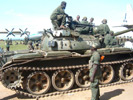
Congo tank

In a dramatic reversal of fortune for one of Central Africa’s most powerful warlords, Congolese rebel leader Laurent Nkunda was arrested by Rwandan authorities last night along the Congo-Rwanda border. When my colleague Rebecca and I met with Nkunda in the town of Rwanguba on Thanksgiving Day, he seemed on top of the world. His rebel movement, the National Congress for the Defense of People, or CNDP, had routed the Congolese army, embarrassed UN peacekeepers, consolidated control of a large swath of North Kivu province, and threatened the regional capital of Goma. Nkunda shrugged off allegations that his lieutenant, Bosco “The Terminator” Ntaganda, had directed a massacre of civilians in Kiwanja, and confidently demanded direct negotiations with Congolese President Laurent Kabila. Journalists flocked to his compound, diplomats had him on speed dial, and the UN appointed a former president of Nigeria to mediate a solution. This morning, Nkunda was in Rwandan custody, and it sounds like he is already back in Congo and headed for detention in the capital, Kinshasa. What happened?

The power play orchestrated by the Congolese and Rwandan governments has been brewing for weeks. As Nkunda’s power and ambition grew, the governments of both Rwanda and Congo came to see him as a serious problem, albeit for different reasons. Unable to defeat Nkunda militarily and unwilling to treat him as a legitimate political actor, President Kabila needed Rwanda’s help to neutralize him. Rwandan President Paul Kagame was stung by Nkunda’s increasingly bold pronouncements (particularly his ambition to take his fight all the way to Kinshsa) and a U.N. panel of experts report documenting Rwandan support for CNDP and involvement with conflict minerals in eastern Congo. European donors began to threaten aid money and Rwanda no longer had plausible deniability that it was not involved with Nkunda.

Congolese officials sought Rwandan help to get rid of Nkunda. The quid pro quo: the Rwandan military would be allowed to re-enter eastern Congo to hunt down the Democratic Forces for the Liberation of Rwanda, or FDLR, a Rwandan Hutu rebel group led by commanders responsible for the 1994 Rwanda Genocide. In a fantastically cynical move, the two sides also agreed that indicted war criminal Bosco Ntaganda would replace Nkunda as head of CNDP, and that his forces would join in the offensive against the FDLR.

A week ago in Goma, Ntaganda announced that he had taken control of CNDP and would collaborate with the Congolese and Rwandan armies against the FDLR. As reported on this blog earlier this week, more than 3,000 Rwandan troops crossed into eastern Congo this past weekend, isolating Nkunda and ultimately arresting him. My colleague John Prendergast noted in the New York Times today, “Now the hard part begins.”

While the move to take more aggressive action to remove the FDLR from eastern Congo and arrest of Nkunda are welcome developments and could contribute mightily to a lasting peace in eastern Congo, there are lots of reasons to be profoundly apprehensive.

  • The planned operations against the FDLR have the potential to be catastrophic for Congolese civilians. The Congolese army and Rwandan armies have abysmal track records in protecting civilians, and the FDLR will almost certainly not stand their ground and fight. As they have done in the past (and as the Lord’s Resistance Army has done in northeastern Congo), the FDLR may well melt into the bush, leave civilians to bear the brunt of the offensive, and return with a vengeance when the operation is over. Moreover, Congo and Rwanda have clear economic motive to assert control over valuable mines in FDLR controlled areas. This could be why the UN peacekeeping force charged with protecting civilians in eastern Congo has been kept deliberately in the dark and is now restricted from traveling to certain areas.
  • The role of Bosco “The Terminator” Ntaganda sends a chilling message about the lack of accountability for crimes against humanity. Ntaganda is wanted for war crimes by the International Criminal Court, and the Congolese government, a signatory to the Rome Statute that established the ICC, is in full violation of international law by failing to arrest him. Human Rights Watch has documented his role in recent massacres.
  • Even though Nkunda has been arrested, allowing Rwandan troops back onto Congolese soil is a dangerous gamble for Congolese President Kabila. Many people in eastern Congo loathe Rwanda for its behavior during the wars that ripped the country apart from 1996 to 2002, when they failed to dislodge the FDLR while looting substantial mineral wealth. The Rwandan military has been able to inflict substantial casualties on the FDLR on the past, but never to the point where they were able to break them as a force. The longer Rwandan forces remain in eastern Congo, the more vulnerable Kabila will be to internal challenges.
  • Lastly, and as Enough has consistently argued, even a successful operation against the FDLR must be accompanied by a process to deal with the other major root causes of conflict in eastern Congo: the fight for control over lucrative natural resources, access to land, economic and physical security of ethnic minorities (particularly Tutsis), and contentious debates over citizenship and identity.

Events are unfolding rapidly on the ground, and Enough is preparing on a statement with recommendations for policymakers on how to help avoid the situation from spiraling downward. We will release the statement next week, but as a first step the Obama administration should immediately appoint a special envoy to the Great Lakes region. The administration has not yet named its Africa policy team, but the people of eastern Congo cannot wait another day for the United States to get engaged at a high level."( THIS POST IS MORE WORRYING )

In a related post from Reuters:

Photo
1 of 1Full Size

By Aaron Gray-Block

THE HAGUE (Reuters) - Congolese militia leader Thomas Lubanga trained child soldiers to kill, pillage and rape, a prosecutor told the International Criminal Court at the start of its first war crimes trial on Monday.

Lubanga, 48, pleaded not guilty on the first day of the historic trial, which opened more than six years after the ICC was set up as the world's first permanent war crimes court.

Lubanga, an ethnic Hema, is accused of enlisting and conscripting children under 15 to his Union of Congolese Patriots (UPC) in Congo's eastern Ituri district to kill rival Lendus in a 1998-2003 war in the Democratic Republic of Congo.

ICC prosecutors say child soldiers recruited by the UPC were involved in hostilities between October 2002 and June 2003, and that some of them were forced to kill, while others lost their lives in combat.

In an opening address to the Hague-based court, chief prosecutor Luis Moreno-Ocampo said Lubanga committed the most serious crimes of concern to the international community -- crimes against children.

"Lubanga's armed group, recruited and trained hundreds of children to kill, pillage and rape. Hundreds of children still suffer the consequences of Lubanga's crimes. They cannot forget what they suffered, what they did, what they saw," he said.

"They cannot forget the beatings they suffered, they cannot forget the terror they felt and the terror they inflicted. They cannot forget the sounds of the machine guns, they cannot forget that they killed. They cannot forget that they raped, that they were raped."

Some of the children were now using drugs, some had become prostitutes, and others were jobless, Moreno-Ocampo said.

He said he intended to demand close to the maximum sentence, which court officials say is life imprisonment.

Moreno-Ocampo showed the court a map indicating where hostilities took place and videos he said showed Lubanga with child soldiers.

"At this stage, our client would like to plead not guilty," Catherine Mabille, lead defence lawyer, told the court.

Dressed in a dark suit and red tie, Lubanga looked impassively ahead as his charges were read aloud to him.

BUNIA LINK-UP

Some 400 people in Congo's eastern town of Bunia -- at the heart of the Hema-Lendu violence -- were watching the trial via video-link, including many UPC supporters, a Human Rights Watch official said.

She said the start of the trial is a signal to the world that there will be accountability for war crimes, but also urged the court to look into officials in Uganda and in Rwanda who armed and supported groups operating on the ground.

More than 30,000 children were recruited during the conflict in Congo, many given marijuana and told they were protected by witchcraft, according to Bukeni Waruzi, the Africa and Middle East coordinator for human rights group Witness.

Lubanga's trial had been due to start in June 2008, but judges postponed because the defence was unable to view some evidence against him.

The matter was resolved in November when prosecutors began releasing documents to the defence that had been provided on condition of confidentiality to protect sources in war zones.

But some procedural measures are still pending.

The three-judge court has allowed 93 victims to take part in the case and give evidence. They can also seek compensation.

Four of the victims are among the 34 witnesses that prosecutor Moreno-Ocampo will call during the trial, which is expected to be completed before the end of the year.

Ethnic violence in the Ituri region between the Hema and Lendu, and clashes between militia groups vying for control of mines and taxation, have killed 60,000( 60,000 ) people since 1999.

Lubanga was handed over to the court in 2006 after Congo referred the case to the ICC prosecutor in March 2004.

The defence will make its opening statement on Tuesday."

In case you want to hear him speak. From the Hub:

DR Congo rebel chief justifies his fight - 21 Nov 08
As the UN agrees to deploys more forces to halt the DR Congo conflict, Laurent Nkunda, the rebel chief, acknowledges partial responsibility for the upheaval in an interview to Al Jazeera's Yvonne Ndege at a secret location in eastern Congo. But insisting that there is "no life, no economy, no administration, no justice", he says "you cannot destroy what is not there".

Wednesday, January 21, 2009

Previous foreign occupations of Congo’s mineral-rich east have been justified by hunts for rebels. Is there a danger of history repeating itself?

From Stop The War In North Kivu:

"
Stearns on today´s events In Analysis, News on January 20, 2009 at 4:56 pm

“This marks a major turning point in Kinshasa’s attitude toward the conflict in the east. It appears (President Joseph) Kabila’s government has decided to turn on what has been an ally, the FDLR.”

“This marks a serious change in Rwanda’s policy as well. For the first time since 2002, Rwandan troops are on Congolese soil.”

“They will now be working together against the FDLR, while the CNDP (Tutsi rebel group), which in the past has received support from Rwanda, will now join ranks with the Congolese army.

“This strategy hinges on the success of the military operations against the FDLR. These kinds of counter-insurgency operations are very difficult and always carry with them the risk of serious harm to the civilian population.”

“The other risk is that these operations could be protracted and Kinshasa has already gone out on a limb inviting back in what has been traditionally perceived as its biggest enemy.”

Not to miss the following Reuter´s dispatch."

"Now, from David Lewis on Reuters:

Tags: Africa Blog, Congo, , , , , , , , , , , , , , , ,

Rwanda sent hundreds of its soldiers into eastern Congo on Tuesday in what the neighbours have described as a joint operation against Hutu rebels who have been at the heart of 15 years of conflict. Details are still somewhat sketchy, with Rwanda saying its soldiers are under Congolese command but Kinshasa saying Kigali’s men have come as observers.

Evidence on the ground suggests something more serious. United Nations peacekeepers and diplomats have said up to 2,000 Rwandan soldiers crossed into Congo. A Reuters reporter saw hundreds of heavily armed troops wearing Rwandan flag patches moving into Congo north of Goma, the capital of North Kivu province. The world’s largest U.N. peacekeeping mission is, for now, being kept out of the loop.( WHAT'S THEIR FUNCTION EXACTLY? )

Foreign soldiers in Congo are nothing new. Rwanda first invaded in 1996. A 1998-2003 war in Congo sucked in six neighbouring armies. But after years of diplomacy and billions of dollars spent on peacekeeping and Congo’s 2006 elections, analysts are frantically trying to work out what is going on. ( TRUE )

The current joint operation stems from an agreement signed in December between Rwanda and Congo to cooperate more closely after weeks of heavy fighting in North Kivu province. Although the fighting was officially between Congolese government forces and Tutsi rebels, most analysts saw it as an escalation of a proxy war between Rwanda and Congo that has continued despite 2003 peace deals.( YES )

U.N. experts have accused Rwanda of supporting the Tutsi CNDP rebels, formed in 2004 out of previous Rwandan-backed movements that fought against the government in Kinshasa. As on many occasions in the past, Congo was, in turn, accused of arming and using Rwandan Hutu FDLR rebels to boost the effectiveness of its fragile and chaotic army.

The fighting underlined the weakness of President Joseph Kabila’s army, which looted and raped civilians as they fled the CNDP. But it also refocused attention on the Hutu rebels, many of whom crossed into Congo when they were routed after taking part in the 1994 genocide of Tutsis and have long since been used by both Rwandan and Congolese Tutsi forces as justification for military operations in the mineral-rich east(NB ).

Rwanda and Congo have frequently agreed to resolve the FDLR problem. With talk of normalising relations, does Tuesday’s intervention by the Rwandan army mark the first concrete step in new a new relationship between the two countries? ( AND THE ANSWER IS? )

How will Kabila sell a Rwandan military intervention in Congo that is likely to be unpopular amongst many ordinary Congolese, who have long-accused Rwanda of entering their country to loot resources rather than remove rebel threats? How will a handful of Rwandans help Congo’s notoriously weak forces disarm the FDLR in 10-15 days after Kigali’s army failed to do the job during several years of occupation?

What is the international community’s role in all this? The U.N. has some 17,000 peacekeepers on the ground but they have largely been kept at a distance. What about the threat of reprisals on civilians? Over 600 people have been killed in recent weeks after another of Congo’s neighbours, Uganda, led an assault on its rebels in a another remote corner of the country.

Previous foreign occupations of Congo’s mineral-rich east have been justified by hunts for rebels. Is there a danger of history repeating itself?"( OF COURSE, BUT WHAT'S THE ALTERNATIVE? )

Can somebody explain to me what the UN soldiers do?

Tuesday, January 20, 2009

"But, above all: Will this make things better, or worse?"

From Stop The War In North Kivu:

"
Our neighbours are here In From the field, News on January 20, 2009 at 3:58 pm

Approximately 2,000 Rwandan soldiers have entered North Kivu this morning through Kibumba. Their deployment is part of an agreement with the government of the DRC to put an end to the presence of FDLR soldiers in the province.

Too many things are happening these days.

As events evolve, I have more and more the feeling of a resource sharing agreement getting real between Rwanda and the DRC. If you can not beat your enemy, join it. Specially if this is the only way you have to receive all the taxes you should be getting for mineral exports. And also if you are under international pressure to find a diplomatic solution. Many Congolese will not be happy with this.

The BBC says that diplomatic and UN sources fear a humanitarian disaster because of a possible lack of military planning and consultation with the international community.

I very much doubt that the key international players have not been consulted. However, the lack of military planning seems clear. I was just talking to someone who came back this afternoon from Rutshuru, and CNDP forces around there were not aware of the Rwandan deployment.

Meanwhile, the CNDP-Nkunda branch has declared their support to the military operation.

A military solution for the FDLR problem has therefore started, and the scenarios are multiple. How long will Rwandan forces remain in the territory? What will be the humanitarian consequences for the people of North Kivu?

But, above all: Will this make things better, or worse?( THE REAL QUESTION )

***

Addendum: CNDP´s taxes have completely stopped. This is great news for the people of Goma, as prices -specially food- will go down in following days.

A rumour circulating in Goma says that Bosco Ntaganda may have received 2,000.000 U$ as part of his agreement. Rumours are rumours. But it would make sense."

Monday, January 19, 2009

"A friend of mine told me today that in this country the highest criminals are not prosecuted… but rewarded. "

From Stop The War In North Kivu:

"
Mistrust In From the field on January 19, 2009 at 5:29 pm

Today I´ve been asking several people what they think about the new prospects of peace announced in the media. The word that describes better what everyone has answered is mistrust, scepticism at best. People don´t trust there will be a real change, at least in the short term.

The record of broken peace deals in the region is quite big, and they all remember several situations like this in the past, where politicians and military where saying this is over… and two days later things started again.

Then why it should be different this time, people wonders.

The issue is not only that former peace deals were broken, but that the reasons for it -the deal- is neither public not clear. That pushes scepticism as much as former broken peace deals.

A friend of mine told me today that in this country the highest criminals are not prosecuted… but rewarded. Many congolese would agree with this. And this is extremely harmful for the health of any society."

Not a positive assessment of the prospects.

Saturday, January 17, 2009

Mende said Congo was aware of its obligation to bring Ntaganda to justice, but the government's first job was to end the fighting in the east

From Stop The War In North Kivu:

"
Big news, secret reasons In Uncategorized on January 17, 2009 at 5:10 pm

This morning I was doing some shopping in the market district (Birere) when a big number of taximotos started to pass by. They may be more than one hundred, many of them claxoning. It looked like a motorbike demonstration, and I asked the shop owner what was happening.

He told me: “the radio says the war is over”.

It is too early to affirm something like this, simply because we are in the Great Lakes region. However, the latest news let us be optimistic. Ntaganda faction has announced the end of fighting. And right after him, the head of PARECO has moved on the same direction.

What makes this news really powerful, though, is the fact that Ntaganda´s declaration of peace has been signed in Goma, in front of the Congolese Interior Minister and, more importantly, in front of Rwanda’s armed forces commander. This is big news, because it publicly shows with whom of the two (Nkunda and Ntaganda) Rwanda is. The bad news is, the split inside CNDP is a reality, and Laurent Nkunda remains silent.

What is Laurent Nkunda going to do? Pressure mounts against him. Does he have the military capacity to continue fighting without Rwanda and Bosco´s faction? It does not seem to be the case.

The real question behind all this is why. What´s the deal?

“Anything that doesn’t end in the arrest of Bosco Ntaganda is in flagrant violation of international law,” Human Rights Watch has repeteadly say. Is Ntaganda´s freedom part of the deal?

The first thing that comes to my mind while I write these lines is: you help us clean the field of FDLR´s and we guarantee that you will not end like Jean Pierre Bemba.

But… what else is the prize to pay for peace?"

Now, from Reuters:

By Joe Bavier


KINSHASA, Jan 17 (Reuters) - A pledge by Congolese Tutsi rebels to abandon their four-year insurgency marks a major step towards ending more than a decade of conflict in the war-ravaged east, Congo's government and foreign diplomats said on Saturday( GOOD NEWS ).

A delegation of commanders from the rebel National Congress for the Defence of the People (CNDP), led by military chief General Bosco Ntaganda, said on Friday it was ready to end its war on government troops and reintegrate with the army( WOW ).

On Saturday, PARECO, the largest pro-government militia operating in eastern Congo and one of the CNDP's primary enemies, said it too was placing its fighters under government command.

"For the government, this is a very good thing that renders the evolution towards peace more real. This is a significant advance," Information Minister Lambert Mende told Reuters.

After rejecting integration of his rebel forces into a new national army after Congo's 1998-2003 war, the CNDP's founder, General Laurent Nkunda, led about 4,000 troops into the bush in 2004.

He said he was acting to protect his fellow ethnic Tutsis from attacks by Rwandan Hutu militia the Democratic Forces for the Liberation of Rwanda (FDLR), some of whom helped carry out Rwanda's 1994 genocide which killed 800,000 Tutsis and moderate Hutus.

Ntaganda, known as "the Terminator" and wanted for war crimes by the International Criminal Court in The Hague, said last week he had overthrown Nkunda, whom he accused of blocking peace efforts.

The commanders' declaration followed an offer by Ntaganda on Thursday to help the governments of Congo and Rwanda fight the FDLR operating in eastern Congo.

Their armed presence there is seen as a root cause of the long-running conflict in North and South Kivu provinces.

"SURRENDER"

Previous attempts to end Nkunda's rebellion, including a January 2008 peace deal, have failed. On and off fighting between the CNDP, the army, pro-government militias and Hutu rebels have forced more than 1 million residents of tiny North Kivu province to flee their homes since late 2006.

However, one Western diplomat told Reuters on Saturday there was now room for fresh optimism that the rebels were finally serious about peace.( VERY GOOD )

"The most significant difference is that it's much more than a cessation of hostilities. It also puts CNDP forces at the disposition of the government command. That is a surrender," he said.

There has been no reaction from Nkunda or those still loyal to him, but the majority of his top commanders signed Friday's declaration, indicating that his support within the movement has waned considerably.

Rights campaigners fear Ntaganda, who was present at Friday's declaration flanked by Congo's interior minister and Rwanda's military chief of staff, may be brought into the army as part of a peace deal.

"Anything that doesn't end in the arrest of Bosco Ntaganda is in flagrant violation of international law," said Anneke Van Woudenberg, a senior researcher with New York-based Human Rights Watch.

In April last year, the ICC issued an arrest warrant for Ntaganda( HE SHOULD FACE CHARGES ), accusing him of recruiting children under 15 to fight in an ethnic-based conflict in northeast Ituri district.

Mende said Congo was aware of its obligation to bring Ntaganda to justice, but the government's first job was to end the fighting in the east.

"We judge it more of a priority to work with Ntaganda to bring back peace. The rest we will come to later," Mende said( THE PRICE TO BE PAID? ). (Additional reporting by John Kanyunyu in Goma; Editing by Daniel Magnowski)"

Friday, January 16, 2009

"If this lasts another six months or a year, they'll start looking for better equipment, and we risk a Mai Mai phenomenon,"

From Stop The War In North Kivu:

"
OCHA humanitarian info on North Kivu In From the field on January 16, 2009 at 1:22 pm

I have just received a report from the Office for the Coordination of Humanitarian Affairs (OCHA) on the information meeting they hold this morning in Goma.

For anyone interested, all their information can be found here."

Let's check in on the Congo. From Reuters:


1 of 1Full Size

By Joe Bavier

DUNGU, Congo (Reuters) - Congolese villagers are forming self-defence groups to protect homes and families from Ugandan LRA rebels.( CAN YOU IMAGINE HAVING TO WORRY ABOUT THE LRA SHOWING UP IN YOUR NEIGHBORHOOD? )

LRA rebels have killed 567 people( 567 ) and displaced 115,000 in northeast Democratic Republic of Congo's Oriental province since September, U.N. refugee agency UNHCR says. Attacks surged after Ugandan forces spearheaded an anti-LRA offensive in December.

In silence broken only by the buzz of insects and the crunch of earth under their plastic sandals, eight men file through the cool night, hunting rifles in hand, scanning the darkness for those who killed their neighbours and burned their homes.

Elsewhere in the areas surrounding the town of Dungu, dozens more like them stalk the forest, mostly farmers and internal refugees armed with locally made guns or bows and arrows.

"This is very necessary for me, first and foremost, for the town, and for the people who are suffering in the bush, who have done nothing and who are dying," said Pascal Kalemba, the bottom half of his boyish face hidden by an airline sleeping mask.

Lord's Resistance Army rebel fighters attacked Dungu in September, as efforts to negotiate a peace deal to end their two-decade bush war against the Ugandan government broke down.

"They just walked straight into town. They started to burn houses and kill people," Kalemba said.

At the time, not a single Congolese soldier was deployed in the town of 57,000 inhabitants, located near Garamba National Park, the LRA's stronghold since it fled to Congo in 2005.

On December 14, a Ugandan-led multinational force, including Congolese and South Sudanese soldiers, launched an offensive aiming to capture the rebels' reclusive leader Joseph Kony.

Instead, the operation splintered the rebels into smaller groups that are now attacking villages, slaughtering civilians, raping women and kidnapping children for use as sex slaves and child soldiers. The U.N. death toll may be conservative.( UNREAL )

New York-based Human Rights Watch says three days of raids alone, starting on Christmas Day, killed at least 600 people. Most were beaten to death with clubs or hacked with machetes.

ARMY "RUNS AWAY"

The head of Dungu's self-defence force, former chief Etienne Dalafata, said despite the deployment of over 3,500 government troops to the area, villages must defend themselves.

"We've already gone on operations with the army, but when we go into the bush they get scared and run away. They are city soldiers," he said.

Dalafata said his force enjoys the town's support and that militias have sprung up across Congo's northern borderlands.

All of this worries Felicien Balani, president of Dungu's local civil society association.

"Our army must make them unnecessary. They find their justification in its ineffectiveness. If this lasts another six months or a year, they'll start looking for better equipment, and we risk a Mai Mai phenomenon," he said.

Mai Mai ethnic militias sprang up across eastern Congo in the 1990s during invasions by Rwanda and proxy rebel groups.

Like Dalafata's men, the Mai Mai initially said they took up arms to protect their communities. But they became notorious for bloody massacres of civilians, rape, and ritual cannibalism.( PLEASE NOT AGAIN )

Since September, the Dungu militia has taken just three LRA prisoners from a number of clashes with the Ugandan rebels.

All, they said, were turned over to the army.

But this week a self-defence patrol in Nzope village on the eastern edge of Garamba caught two LRA suspects. It mutilated and killed one before handing the other over to the authorities.

In Dungu, Kalemba said he feels no hatred for these latest invaders. He simply wants them to go home.

"Why are they persecuting us? Why?" he said.

"If it comes to a battle, we will die together."

I truly believe that indifference allows this to happen. Shame on us! Including me.

Wednesday, January 14, 2009

there are many informations regarding an acute increase of human rights violations in three territories under CNDP control

An update from Stop The War In North Kivu:

"
Kiwanja: threats and extortions increasing In From the field on January 13, 2009 at 5:07 pm

According to relevant sources, CNDP´s pressure towards Internally Displaced People (IDPs) in Kiwanja has severely increased. In the last two weeks, soldiers have been asking IDPs to pay 2 U$ per day as a “tax to remain in the IDP camp”. Things are going far beyond. CNDP soldiers are threatening men, women and children to occupy their homes if they do not return home. Some of the houses have been seized, and padlocks have been placed in some visible door entrances to increase pressure. ( TERRIBLE )

As readers of this blog know, IDPs remain in the camp of Kiwanja because they fear for their lives.

Meanwhile, there are many informations regarding an acute increase of human rights violations in three territories under CNDP control: Kitchanga, Mweso and Kirolire. According to sources, the lack of discipline showed by CNDP soldiers in these areas is related to the leave of high ranking CNDP officials towards Rutshuru."

This is turning into a chaotic mess of rampaging war criminals.

Sunday, January 11, 2009

Personne n’a la situation en main. La situation est encore confuse.

From Stop The War In North Kivu;

"
Nkunda´s biographer on CNDP split In News on January 10, 2009 at 4:24 pm

Je crois qu’il y a une volonté du général Bosco Ntaganda de s’émanciper. Ce n’est pas la première fois que cela se produit. L’année dernière, il y a déjà eu deux rumeurs faisant état d’une scission au sein du CNDP. La première, début 2008, annonçait la formation de deux nouveaux mouvements rebelles dissidents du CNDP dont l’un serait dirigé par Ntaganda et l’autre par Matienga. La deuxième date de fin septembre début décembre, et faisait état de la mort de Nkunda. Mais là, ce n’est plus une rumeur, c’est la première crise majeure que connait le mouvement. Ntaganda affiche clairement ses intentions. On s’oriente clairement vers une scission mais la situation est encore confuse pour le moment. On ne sait pas qui est avec qui. Il est tout à fait évident que les autres belligérants du conflit dans le Nord Kivu pourraient profiter de ce clash au sein du CNDP.

(…)

Personne n’a la situation en main. La situation est encore confuse. Laurent Nkunda a tenté de jouer la carte d’apaisement mais cela n’a pas marché. Comme je le disais tantôt, on ne sait pas, pour l’heure, qui est avec qui. C’est sûr qu’il va se passer des choses dans les jours à venir, il y a réellement un problème. Mais je crois que le mouvement politique est encore en grande majorité acquis à Laurent Nkunda.

Read more here."

JPEG - 21 ko

Stewart Andrew Scott est l’auteur d’une biographie du chef rebelle, Laurent Nkunda et la rébellion du Kivu : au coeur de la guerre congolaise parue en décembre aux éditions Karthala. Chercheur en science politique, M. Scott a rencontré à plusieurs reprise le chef rebelle. Il a eu la possibilité de passer plusieurs mois sur les lignes de front du Nord-Kivu. Il travaille depuis une dizaine d’années le Congo depuis des années et son activité lui a permis d’enquêter dans les territoires des différents belligérants et d’être en contact étroit avec les populations. Il raconte sa rencontre avec Laurent Nkunda et revient sur la crise interne du CNPD.

Afrik.com : Laurent Nkunda vous a reçu récemment dans son fief de Jomba. Avez-vous perçu, lors de cette rencontre, des signes d’une tension au sein du groupe ?
Stewart Andrew Scott :
J’ai rencontré Laurent Nkunda samedi dernier, dans son fief et à ce moment il n’y avait apparemment aucune tension. L’atmosphère était plutôt détendue. Je pense que les déclarations du général Bosco Ntaganda ont été une surprise pour tous.( WHAT'S HE UP TO THEN ? )

Afrik.com : On semble aller vers une scission au sein du groupe, comment expliquez-vous cela ?
Stewart Andrew Scott :
Je crois qu’il y a une volonté du général Bosco Ntaganda de s’émanciper. Ce n’est pas la première fois que cela se produit( IT'S HAPPENED BEFORE ? ). L’année dernière, il y a déjà eu deux rumeurs faisant état d’une scission au sein du CNDP. La première, début 2008, annonçait la formation de deux nouveaux mouvements rebelles dissidents du CNDP dont l’un serait dirigé par Ntaganda et l’autre par Matienga. La deuxième date de fin septembre début décembre, et faisait état de la mort de Nkunda. Mais là, ce n’est plus une rumeur, c’est la première crise majeure que connait le mouvement. Ntaganda affiche clairement ses intentions( WHICH WERE? ). On s’oriente clairement vers une scission mais la situation est encore confuse pour le moment.( VERY ) On ne sait pas qui est avec qui. Il est tout à fait évident que les autres belligérants du conflit dans le Nord Kivu pourraient profiter de ce clash au sein du CNDP. ( THAT SEEMS RIGHT )

Afrik.com : Avez-vous le sentiment que Laurent Nkunda tient toujours les commandes sur CNDP ?
Stewart Andrew Scott :
Personne n’a la situation en main. La situation est encore confuse. Laurent Nkunda a tenté de jouer la carte d’apaisement mais cela n’a pas marché. Comme je le disais tantôt, on ne sait pas, pour l’heure, qui est avec qui. C’est sûr qu’il va se passer des choses dans les jours à venir, il y a réellement un problème. Mais je crois que le mouvement politique est encore en grande majorité acquis à Laurent Nkunda( HE'S GOT THE UPPER HAND? ).

Afrik.com : Est-ce que Laurent Nkunda a la capacité de faire arrêter le général Bosco Ntaganda ?
Stewart Andrew Scott :
On verra. Tout déprendra de l’évolution de la situation. La question inverse peut bien être aussi posée : est ce que Ntaganda peut arrêter Nkunda ? C’est peu probable, mais on verra. ( WOW )

Afrik.com : Le général Ntaganda affirme que Nkunda empêche la paix en RDC. Partagez-vous ce point de vue ?
Stewart Andrew Scott :
A partir du moment où il mène un conflit armé, Laurent Nkunda empêche la paix. Mais le général Bosco Ntaganda invoque aussi d’autres raisons parmi lesquelles des présumés détournements de fonds de Laurent Nkunda. Il sait que c’est un sujet sensible au sein du groupe. Son discours est une stratégie de communication qui a pour objectif de décrédibiliser Laurent Nkunda et de rallier le plus grand nombre possible de gens à sa cause.( CAN IT WORK? )

Afrik.com : Pensez-vous qu’il y a une volonté de Laurent Nkunda d’aller vers une paix durable ?
Stewart Andrew Scott :
Je pense que dans les deux camps il y une rupture de confiance. La convention qui a été conclue et qui prévoit la chasse aux FDLR ne sera certainement pas respectée. Cela était déjà contenu dans le programme amani, mais personne ne l’a jamais respecté. Parce que le gouvernement s’appuie sur le FDLR qui est une armée bien organisée pour combattre le CNDP. Et de l’autre côté, les revendications du CNDP ne pourront pas être satisfaites.

Afrik.com : Les médiateurs du conflit reprochent justement au CNDP sa position ambigüe dans les négociations. Ses revendications qui portaient sur le conflit dans le Nord Kivu, ont été portées au plan national. On a finalement l’impression que le CNDP ne veut pas aboutir à un accord de paix…
Stewart Andrew Scott :
Sans porter un jugement de valeur( WHY NOT ? ), cela ne me surprend pas que le CNDP porte les négociations à un niveau national. Sur le terrain, cela est évident depuis un an bientôt que le discours de la rébellion a changé. Depuis début 2008, le mouvement se veut national( REALLY? ). Sur le site internet du CNDP, les revendications portaient déjà sur la gestion du pays et pas seulement sur les problèmes dans le Nord Kivu. C’est à tort que les médias parlent encore de mouvement tutsi.

Afrik.com : Dans le livre que vous venez de publier, vous décrivez Laurent Nkunda comme un chef de guerre atypique. Pourquoi ?
Stewart Andrew Scott :
Déjà au contact, c’est quelqu’un d’atypique. C’est un chef de guerre cultivé qui n’est pas, contrairement à ce qu’on peut imaginer, dans la démarche de prédation. Il a une palette impressionnante de connaissances, il parle plusieurs langues (Kinyarwanda, le swahili, le français, l’anglais….BS ). C’est quelqu’un qui est à l’écoute, mais qui n’est pas influençable. Il cherche à détecter des gens qui peuvent lui apporter quelque chose. Il s’est ainsi entouré d’ingénieurs, de médecins, de psychologues… qui ne sont pas forcément de son ethnie. J’ai connu des chefs de guerre au Liberia, Laurent Nkunda tranche avec eux.( MAYBE. FOR WHAT IT'S WORTH, HE SEEMS BETTER THAN NTAGANDA. )

Afrik.com : Qu’est ce qui vous a poussé à l’écriture de ce livre ?
Stewart Andrew Scott :
Quand on voit ce qui se passe aujourd’hui en RDC, on se dit que c’est un énorme gâchis vu toutes les ressources dont dispose ce pays. On a envie de comprendre les raisons du conflit qui dure de plusieurs années et qui a fait des millions de morts. A un moment donné, mes lectures sur le sujet ne suffisaient plus( TRUE ). J’ai commencé à les critiquer( Bon ). Je suis allé sur le terrain, j’ai rencontré des gens, j’ai fait mes propres enquêtes. Cela a débouché sur un livre. Et j’ai décidé de mettre un personnage au centre de l’histoire, et de raconter l’histoire de ce pays et du conflit à travers lui. Laurent Nkunda m’a paru le plus intéressant.( TO YOU )

Afrik.com : comment avez-vous rencontré Laurent Nkunda ?
Stewart Andrew Scott :
J’ai rencontré les gens de son mouvement, je leur ai parlé de mon projet, ils l’ont rapporté. Il m’a reçu un jour dans son maquis, je lui ai expliqué ce que je voulais faire et l’indépendance que je voulais garder. Il m’a juste demandé de respecter l’anonymat de ceux qui le souhaiteraient. Pour le reste, il m’a donné carte blanche ( REALLY? )

Lire aussi :

- RDC : négociations tendus entre le gouvernement et la rébellion
- RDC : gouvernement et rebelles autour de la table de négociations
- RDC : vers un dialogue entre gouvernement et rebelles"


Thursday, January 8, 2009

It is hard to think about how tens of thousands of men, women and children spent the last night in the camps.

From Stop The War In North Kivu:

"
Buhimba In videos on January 8, 2009 at 8:41 pm

It was cold in Goma last night. Cold even for the standard of someone sleeping in a good room with two blankets.

It is hard to think about how tens of thousands of men, women and children spent the last night in the camps. To make things worse, few have enough wood for heating. And to make things worse, they have to be very careful by doing so. If your sheeting gets burned, you will never get a new one. Everyone knows that.

The rain also came early in the morning.

This view of Buhimba IDP camp was taken yesterday.

Tuesday, January 6, 2009

"The fate of hundreds of thousands of men, women and children living as IDPs will lie tomorrow on that table of negotiations."

An interesting situation in the Congo. From Reuters:

Photo
1 of 1Full Size

By John Kanyunyu

GOMA, Congo (Reuters) - A split emerged on Tuesday in Congo's eastern Tutsi rebellion after the movement's top military commander openly challenged founder General Laurent Nkunda in an apparent power struggle.( WOW )

Senior military and political representatives of the rebel National Congress for the Defence of the People (CNDP) rejected an announcement by its military chief of staff, General Bosco Ntaganda, that he had deposed Nkunda as the group's leader.

Signs of a split emerged as the Tutsi rebel movement, whose attacks in east Democratic Republic of Congo in recent months have displaced a quarter of a million civilians, was preparing to resume peace talks this week with Congo's government.

In a statement to the BBC late on Monday, a spokesman for Ntaganda, who is wanted by the International Criminal Court for war crimes, said the CNDP's military commanders had decided to oust Nkunda because of his "bad governance".

This was quickly denied by other CNDP spokesmen.

"General Bosco Ntaganda does not have the authority to depose the chairman Laurent Nkunda. The CNDP remains one movement and one army," Col. Sultani Makenga, the group's military second in command, told Reuters. He said he did not know why Ntaganda had made the announcement.

Attempts to contact Ntaganda, known as "the Terminator" and popular among the rebel rank and file, were unsuccessful.

After launching a renewed offensive in late August, Nkunda's battle-hardened rebels routed President Joseph Kabila's army and captured large swathes of Congo's eastern North Kivu province before declaring a unilateral ceasefire in late October.

The fighting triggered a fresh humanitarian emergency in the border province, where conflict between rival rebels, militias and the government army has raged on despite a formal end to a wider 1998-2003 war in the former Belgian colony.

United Nations officials and human rights campaigners said the CNDP leadership may have planned to discipline Ntaganda over the massacre of around 150 civilians in the North Kivu town of Kiwanja, shortly after it was seized by the rebels in November.

Up to now, the CNDP has denied its fighters slaughtered civilians, blaming rival pro-government Mai-Mai militiamen.

U.N. PEACEKEEPERS ON ALERT

Officials from Congo's 17,000-strong United Nations peacekeeping force (MONUC) said they were monitoring the situation closely in case of fighting within the CNDP.

"To the extent these events threaten to aggravate the situation on the ground, we are very concerned," said Kevin Kennedy, a MONUC spokesman.

Talks between the CNDP rebels and government representatives are due to restart on Wednesday in the Kenyan capital, Nairobi, under U.N. and African Union mediation.

CNDP political spokesman Bertrand Bisimwa said Ntaganda's announcement had no impact on the group's leadership structure, and negotiators still planned to attend the talks in Kenya.

"If an officer has demands, he must address them to the movement itself and not the media," he said. "Our disciplinary body is being activated to deal with this situation."

A spokesman for Congo's government said its negotiators were also planning to go ahead with the talks on Wednesday.

In April last year, the ICC issued an arrest warrant for Ntaganda, accusing him of recruiting children under 15 to fight in a bloody ethnic-based conflict in northeast Ituri district.

Ntaganda is a former associate of Ituri militia leader Thomas Lubanga, who is in ICC custody in The Hague ahead of his own trial on charges of recruiting child soldiers.

Ntaganda returned to his native North Kivu in 2006, where he joined the CNDP led by Nkunda, who says his rebels seek to defend Congo's Tutsi minority against persecution by the government and by Rwandan Hutu militiamen in the east.

Nkunda has so far refused to hand over Ntaganda to Congolese or international authorities, demanding that the ICC first share evidence with the CNDP proving his guilt of war crimes."

Here's the take of Stop The War In North Kivu:

"According to different sources, Bosco Ntagana has replaced Laurent Nkunda as head of CNDP. It still has to be confirmed at the official webpage of this armed group.

Some Congolese media talk about Rwanda choosing Ntagana in order to harden peace negotiations, while other stress that his replacement is a consequence of the recent UN report released by a panel of experts on the DRC.

It is a worrying move taking place in a key moment. The replacement at the head of CNDP happens just before the beggining of the third round of the current peace talks.

The fate of hundreds of thousands of men, women and children living as IDPs will lie tomorrow on that table of negotiations. Unfortunately, I am afraid that none of the speakers sitting on both sides of that table will truly care about them."

It's hard to see how a war criminal taking over can help things.